Stored cross site scripting — also called persistent cross site scripting — is the variant where the attacker writes once and every subsequent viewer pays. The payload lives in the database, in a user profile, in a forum thread, in a support-ticket comment, in a log viewer the admins open every morning. Each render of that stored content fires the script in the viewer's browser, in the application's origin, with the viewer's session cookies in scope. Where reflected XSS demands a tailored phishing link to each victim, stored XSS turns the application itself into the delivery mechanism. This guide walks the attack flow that makes cross site scripting persistent the most dangerous variant in the family, the storage surfaces where it actually lives in 2026 codebases, the historical worms that proved its amplification factor, and the rendering-time encoding and sanitization playbook that prevents it.
What Is Stored (Persistent) XSS?
Stored XSS is a cross-site scripting attack in which the malicious payload is saved on the server — database, object storage, log file, cached fragment — and is later rendered into pages served to other users. The attack has two temporal phases: a write phase, where the attacker submits the payload, and a read phase, where every visitor who loads a page including the stored content executes it in their browser. The two phases can be separated by minutes, days, or years.
The XSS family — covered in our cross-site scripting pillar guide — splits along a persistence axis. Reflected XSS bounces a payload off a single request and only affects the user who clicked the crafted link. DOM-based XSS happens entirely in the browser, with the payload reaching a dangerous JavaScript sink without ever touching the server. Stored XSS persists on the server side and reaches every viewer of the affected page. All three share the same root cause — untrusted data interpreted as HTML or JavaScript — but stored XSS amplifies the impact through persistence and reach in a way the other two cannot.
The reason persistent XSS is consistently rated the most dangerous variant is mathematical. Reflected XSS requires the attacker to deliver the malicious URL to each victim individually — social engineering, phishing infrastructure, an inbox filter to evade. Stored XSS requires submitting the payload once and the application delivers it to every viewer automatically. The cost of attack scales O(1); the impact scales with the number of users who load the affected page. On a forum thread, that is every visitor. On a profile field rendered into search results, every search. On an admin panel widget, every administrator who logs in.
The Stored XSS Attack Flow
The attack flow is short and worth memorizing because it is the shape every stored XSS finding takes. First, the attacker identifies an input field that accepts user content and is rendered back into pages other users will see — comment forms, profile bios, display names, message bodies, support tickets, file upload metadata, error log viewers. Second, the attacker submits a payload that, when rendered without proper output encoding, will be parsed by the browser as HTML or JavaScript. The payload might be a simple <script> that exfiltrates the session via fetch, or an event handler on a benign-looking element designed to evade naive filters.
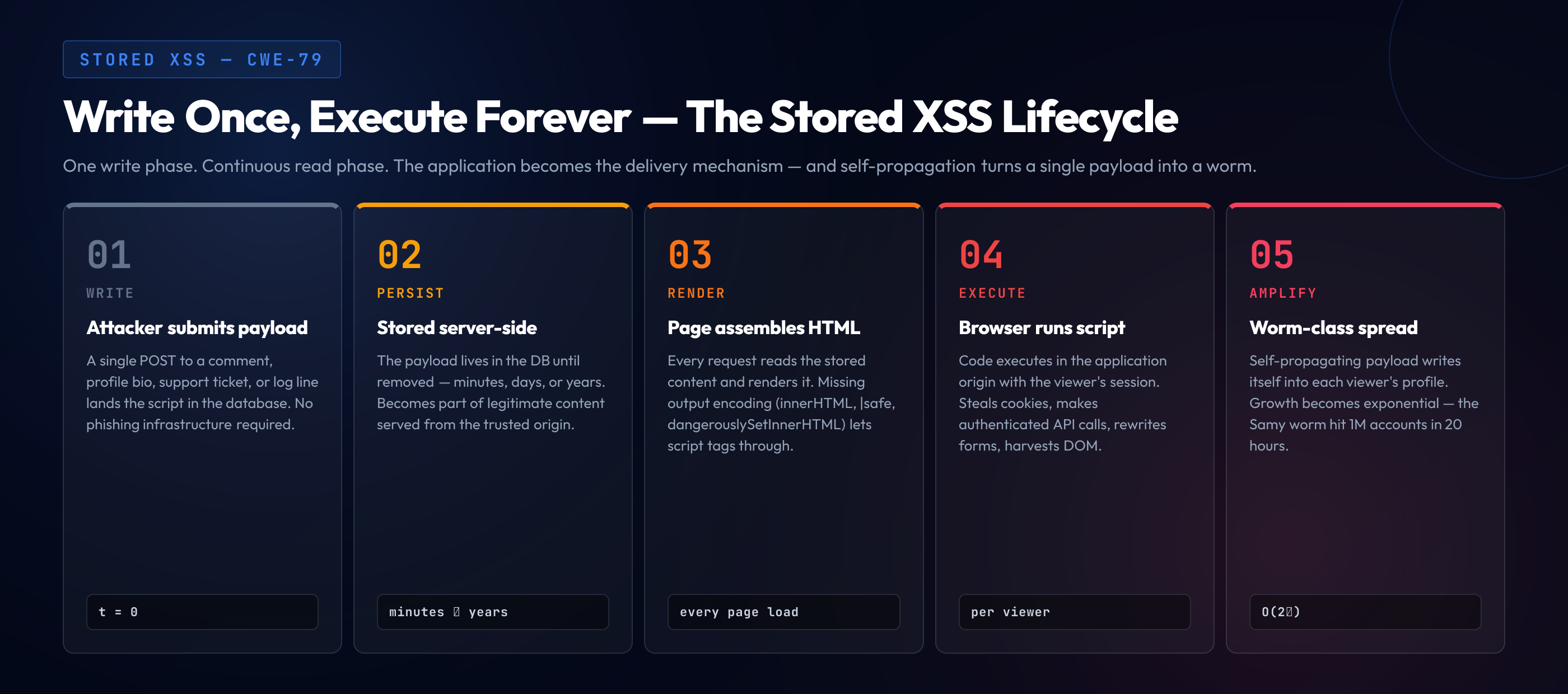
Third — the step that makes stored XSS qualitatively different from reflected XSS — the attacker walks away. There is no phishing campaign, no crafted URL, no need to convince a target to click anything. The payload is now part of the application's content, served by the legitimate origin, in the application's cookie scope. Every user who loads the affected page is a victim. The attacker can return hours later to collect harvested session cookies and exfiltrated DOM contents from a controlled endpoint, or chain the payload into a self-propagating worm that infects new users' profiles and turns them into delivery vectors.
The viewer-side execution carries the full weight of the application's origin. The script runs as if the application itself wrote it: it can read cookies that are not HttpOnly, make authenticated API calls with the viewer's session, read DOM content, phish credentials, install a service worker that persists across navigations, or rewrite forms to exfiltrate submitted data. The browser has no way to distinguish "JavaScript the application's developers wrote" from "JavaScript an attacker stored in the database three months ago" — both come from the same origin with the same authority.
Where Stored XSS Lives
The storage surfaces that produce stored XSS in 2026 are not exotic. They are the fields any application has and the views any application renders. The list below is the audit checklist worth running against every application during secure code review:
- Comments and forum posts — the canonical surface, especially when the application supports any form of rich text or markdown.
- Profile fields — display names, bios, URLs, custom statuses. A display name rendered into a "Last edited by" caption on every page becomes an organization-wide stored XSS vector.
- Direct message bodies — chat applications that render messages as HTML, especially when link unfurling pulls remote content.
- Support ticket fields — ticket titles and bodies rendered in admin dashboards. The viewer here is a privileged user, which raises the impact significantly.
- Admin panels and log viewers — application logs that include user-controlled data (User-Agent strings, request paths, error messages with raw user input) rendered as HTML in a log-viewer UI. An attacker who can write to the log writes a payload that fires on every admin who opens the dashboard.
- File upload metadata and preview — filenames, EXIF data, document titles, alt text. SVG uploads are a special case: SVG is XML that allows embedded scripts, and serving an SVG from the application's origin executes the script.
- Webhook payload echo — applications that store and display webhook payloads verbatim for debugging.
- Imported data — CSV imports, vCard contacts, calendar invites, anything pulled from a third-party API and rendered into the UI without sanitization.
The pattern across all of these is identical: a write boundary that does not sanitize, plus a render boundary that does not encode. The defense lives at the render boundary, and the audit question is — for every database column with user-controllable text, where does it get rendered, and is the render path safely encoding or sanitizing it?
Stored vs Reflected XSS: When Each Is More Dangerous
Developers often ask which is "worse" — stored vs reflected XSS. The honest answer is that stored XSS is almost always more dangerous in practice, but the comparison is worth laying out because the differences inform the mitigation priorities.
| Property | Stored XSS | Reflected XSS |
|---|---|---|
| Persistence | Lives in DB until removed; can persist for months or years | One request lifetime; gone when the URL is closed |
| Delivery | Application serves it automatically to every viewer | Attacker must deliver crafted link to each victim |
| Scope | Every user who loads the affected page | Only users who click the crafted link |
| Social engineering | None required after the initial write | Phishing or link-injection required per victim |
| Detection difficulty | Often noticed only when the payload triggers visibly | Easier to flag in WAF logs (single request, telltale params) |
| Worm potential | High — payload can propagate to new profiles | None — each victim requires fresh delivery |
| Worst case | Site-wide compromise via self-propagating script | Account takeover of clicked-link victims |
Reflected XSS can match stored XSS in real-world impact only in narrow cases — a reflected XSS in a high-traffic search endpoint shared widely on social media, or one chained with a CSRF token leak. Even then, the attacker must push the URL into circulation; with stored XSS, the application does the pushing. For the sibling variants, see our reflected cross site scripting guide and the DOM-based XSS guide.
The Amplification Factor
The amplification factor turns a single stored XSS payload into a site-wide event. Three multipliers compound.
The first multiplier is the viewer count. A payload stored in a popular forum thread or a high-traffic profile reaches every viewer. A payload in an admin log viewer reaches every administrator. The same payload in different storage locations has very different impact ceilings.
The second multiplier is time. The payload runs every time the page is rendered. Reflected XSS has a single victim per delivery; stored XSS accumulates victims continuously until the payload is removed. Mean time from initial write to remediation is usually measured in days or weeks, because stored XSS often is not noticed until a user reports unusual behavior.
The third multiplier — the one that produces catastrophic incidents — is self-propagation. A payload that, when executed, posts itself into the viewer's profile or message stream creates a worm. Each new viewer becomes a new propagator. The growth curve is exponential until the entire active user base is infected or defenders quarantine the propagation. The historical incidents in the next section illustrate the curve.
Real-World Stored XSS Incidents
Three incidents in the historical record demonstrate the worm-class amplification that distinguishes stored XSS from every other web vulnerability category.
The Samy worm — MySpace, October 2005. Samy Kamkar published a stored XSS payload in his MySpace profile. The payload exploited a flaw in MySpace's HTML filtering — a CSS attribute that allowed JavaScript via legacy IE syntax — to execute when any logged-in user viewed his profile. The script added "but most of all, samy is my hero" to the viewer's profile and added Samy as a friend on the viewer's account. Because the modified profile now contained the same payload, every user who viewed an infected profile became a new propagator. In under 20 hours, Samy had over a million friend requests, MySpace took the entire site offline to quarantine the spread, and Kamkar was eventually sentenced to three years probation. The technical lessons — that filter blocklists are inferior to allowlists, that worm-class amplification is real — shaped the next decade of XSS-prevention thinking.
The Twitter onMouseOver worm — September 2010. A stored XSS in Twitter's tweet rendering allowed JavaScript to execute via the onMouseOver event handler when a user hovered over a crafted tweet. Payload variants emerged within hours, including one that auto-retweeted the malicious tweet to the viewer's followers, producing self-propagation across the platform. Public figures and accounts with large followings were repeatedly affected as their followers' timelines became delivery channels. Twitter patched within a few hours, but the incident demonstrated that any high-engagement platform with stored content rendering becomes a worm substrate the moment HTML escaping fails.
The eBay listing XSS — 2014. Researchers and journalists documented stored XSS in eBay product listings that persisted for months, allowing attackers to inject scripts into legitimate-looking listings that redirected viewers to phishing pages stealing eBay credentials. eBay's response was widely criticized as slow, with reports of vulnerable listings remaining live well after initial disclosure — a case study in operational risk where even a straightforward technical fix fails when the detect-and-quarantine capability is not exercised at scale.
Code-Level Vulnerabilities and Their Fixes
The four pairs below show the patterns that produce stored XSS in modern stacks and the rendering-time fixes that prevent them. Each pair is small; each generalizes to dozens of variants in real codebases. The unifying principle for every fix in this section: encode or sanitize at the render boundary, not the input boundary. The reason is covered in the mitigation section that follows.
Node.js: comment storage rendered via innerHTML. The vulnerable pattern accepts a comment body, stores it in the database verbatim, and renders it into the DOM with innerHTML. Any HTML tags or script handlers in the stored body are parsed and executed.
// VULNERABLE — Express handler stores body verbatim
app.post('/comments', async (req, res) => {
  await db.comments.insert({
    body: req.body.comment,
    author: req.user.id,
  })
})

// VULNERABLE — frontend renders via innerHTML
function renderComment(comment) {
  const el = document.createElement('div')
  el.innerHTML = comment.body  // attacker's <script> runs here
  return el
}
The fix at the render boundary is to use textContent instead of innerHTML when the comment is plain text, or to run the body through DOMPurify with a strict allowlist when limited HTML must be supported.
// FIXED — plain-text path
function renderComment(comment) {
  const el = document.createElement('div')
  el.textContent = comment.body  // browser treats as text, never parses as HTML
  return el
}

// FIXED — rich-text path with DOMPurify allowlist
import DOMPurify from 'dompurify'
function renderComment(comment) {
  const el = document.createElement('div')
  el.innerHTML = DOMPurify.sanitize(comment.body, {
    ALLOWED_TAGS: ['b', 'i', 'em', 'strong', 'a', 'p', 'br'],
    ALLOWED_ATTR: ['href'],
  })
  return el
}
PHP: profile bio echoed without encoding. The vulnerable pattern stores a user bio and echoes it directly into the page template. PHP's bare <?= $bio ?> writes the value as-is, so any HTML in the bio is parsed by the browser.
// VULNERABLE — raw echo
<div class="bio"><?= $bio ?></div>

// FIXED — HTML-encoded for plain text
<div class="bio"><?= htmlspecialchars($bio, ENT_QUOTES | ENT_HTML5, 'UTF-8') ?></div>

// FIXED — sanitized for limited rich text via HTML Purifier
<div class="bio"><?= $purifier->purify($bio) ?></div>
The ENT_QUOTES flag encodes both single and double quotes, which matters when the value flows into an attribute context elsewhere. Choosing the right encoding for the right context is the discipline of context-aware output encoding, expanded in the XSS prevention defense-in-depth guide.
React: rich-text comment via dangerouslySetInnerHTML. React's automatic JSX escaping makes the framework safe by default. The escape hatch — dangerouslySetInnerHTML — disables the escaping and is the most common stored XSS pattern in React codebases.
// VULNERABLE — raw HTML injection
function Comment({ comment }) {
  return <div dangerouslySetInnerHTML={{ __html: comment.body }} />
}

// FIXED — sanitize before injection
import DOMPurify from 'dompurify'
function Comment({ comment }) {
  const safe = DOMPurify.sanitize(comment.body, {
    ALLOWED_TAGS: ['b', 'i', 'em', 'strong', 'a', 'code', 'pre'],
    ALLOWED_ATTR: ['href'],
  })
  return <div dangerouslySetInnerHTML={{ __html: safe }} />
}

// PREFERRED — avoid HTML entirely when possible
function Comment({ comment }) {
  return <div>{comment.body}</div>
}
The third form is preferred when the application does not need HTML in comments. JSX's default escaping renders {comment.body} as text. dangerouslySetInnerHTML is named the way it is for a reason; every appearance in a codebase is worth a security review comment.
Python: Jinja2 template with the safe filter. Jinja2 auto-escapes by default in most modern setups (Flask's default, Django templates' default). The escape hatch is the |safe filter, which marks a value as pre-trusted HTML. Applied to user-controlled data, |safe is a stored XSS vulnerability waiting to render.
{# VULNERABLE — bypasses auto-escape #}
<div class="comment">{{ comment.body|safe }}</div>

{# FIXED — let auto-escape handle plain text #}
<div class="comment">{{ comment.body }}</div>

{# FIXED — sanitize markdown via bleach for rich text #}
<div class="comment">{{ comment.body|markdown|sanitize_html }}</div>
In the third form, sanitize_html is a custom filter that wraps Bleach with a strict tag and attribute allowlist. The pattern — markdown to HTML, then HTML through a sanitizer — is the standard approach for user-supplied rich text in Python applications.
Mitigation Playbook
The patterns above all converge on a small set of mitigations. Applying them consistently across every render path is what closes the stored XSS surface.
Encode at render time, not input time. The single most important rule, and the most commonly violated. Encoding at input time stores a transformed value that may later be rendered in multiple contexts — HTML body, attribute, JavaScript string, URL parameter, CSS — each with different encoding requirements. A value HTML-encoded at input time is wrong for a JavaScript context and wrong for an attribute context. Storing raw user input and encoding at the render boundary lets each render apply the encoding appropriate to its context. The exception is rich-text HTML sanitization with a tag allowlist, which can happen at write time but still must be rendered into a context that does not double-encode it.
Use a vetted sanitization library. Do not write your own HTML sanitizer. The list of bypass techniques against home-grown sanitizers is decades long. Use DOMPurify for browser and Node, Bleach for Python, HTML Purifier for PHP, OWASP Java HTML Sanitizer for JVM, sanitize-html for additional Node options. Configure each with an explicit allowlist of tags and attributes — never a blocklist. Allowlist any URL schemes you accept (typically http, https, mailto) and reject javascript:, data:, and other script-bearing schemes.
Apply Content Security Policy as the runtime safety net. A strict, nonce-based or hash-based CSP that blocks inline scripts and restricts script sources is the second layer — when output encoding fails, CSP refuses to execute the injected script. CSP is part of security misconfiguration discipline; the XSS-specific configuration is in the defense-in-depth guide.
Set HttpOnly and SameSite on session cookies. Session cookies marked HttpOnly are not accessible to JavaScript, which neutralizes the most common stored XSS impact (session theft). SameSite=Lax or Strict mitigates CSRF chains. Neither prevents stored XSS itself, but both reduce the damage when a payload does execute.
Allowlist for rich text; default-deny for everything else. Every field that accepts user input falls into one of two categories: plain text (encode aggressively, allow no HTML) or rich text (sanitize aggressively, allow a narrow tag and attribute set). Treat the allowlist as the security boundary, not the blocklist of forbidden patterns. Blocklists are perpetually behind the bypass research.
Treat XSS as the JavaScript-context member of the broader injection family. XSS was folded into A03 in the 2021 OWASP reorganization for a reason: the underlying pattern — untrusted data interpreted as code by a downstream interpreter — is identical to the pattern in our OWASP A03 injection guide. The mitigation discipline is the same: separate code from data, parameterize through the protocol, validate and encode at the boundary.
Detection
Stored XSS detection runs across multiple complementary methods. The combination matters more than any single tool.
DAST against authenticated flows. Black-box scanners — OWASP ZAP, Burp Suite, Nuclei — submit XSS test payloads through every input field and look for the payload in subsequent renders. Stored XSS detection requires the scanner to authenticate, submit content, then re-fetch the pages where the content is displayed. Configure the scan to cover both the immediate response (which catches reflected variants) and the secondary fetches (which catches stored variants).
Manual testing with creative storage paths. Automated scanners miss the storage surfaces they do not know to test — admin log viewers, infrequently visited profile fields, file upload metadata, webhook payload echoes. A penetration tester walking through every storage write and every render path catches the surfaces a scanner does not crawl.
Storage audit grep. A high-leverage check: list every database column with user-controlled text, trace where each is rendered, and verify every render path uses the framework's auto-escape or runs through a sanitization library. The audit catches patterns SAST often misses because the source-to-sink data flow crosses the database boundary.
SAST with stored-XSS data flow. Modern SAST tools — CodeQL, Semgrep, Snyk Code — can trace data flow from request inputs through database writes through database reads to render sinks. Configure them to flag any user-controlled value reaching innerHTML, dangerouslySetInnerHTML, |safe, raw template expansion, or unencoded echo without passing through a known sanitizer.
CSP violation reporting. A strict CSP with report-to directives produces violation reports when injected scripts are blocked. The reports are an early-warning signal of stored XSS attempts in production — even when the CSP successfully blocks execution, the attempt itself is intelligence.
A Sanitizer Is a Library. The Discipline to Reach for It Is a Skill.
Every modern framework ships with the tools to prevent stored XSS — DOMPurify, Bleach, HTML Purifier, framework-default escaping. The findings still appear in pentest after pentest because the developer wrote dangerouslySetInnerHTML, |safe, or innerHTML on a user-controlled value and shipped it. SecureCodingHub builds the rendering-boundary, allowlist-first, escape-hatch-aware fluency that catches stored XSS at code-review time instead of at incident-response time. If your team keeps finding stored XSS in production, we'd be glad to show you the program that changes the input side of the pipeline.
Stored XSS persists in 2026 codebases not because the prevention is unknown but because the storage and render boundaries are everywhere — every comment, profile, log line, imported field. The mitigation is to recognize the pattern in every render path, encode or sanitize at the render boundary, allowlist the rich-text subset, layer CSP as the runtime safety net, and treat every innerHTML, |safe, and dangerouslySetInnerHTML as a code-review checkpoint. Persistent cross-site scripting is the variant that produces the worm-class incidents; the discipline that prevents it pays back across every render path the application ships.