More production breaches trace back to security misconfiguration than to any single code-level vulnerability. An S3 bucket left public. A debug endpoint exposed in production. Default admin credentials that were never rotated. A CORS policy that allows every origin. An API gateway that leaks stack traces. Each of these is, by itself, a dull technical detail — but in aggregate they are the single biggest source of data exposure in the 2026 incident landscape, and the OWASP Top 10 has recognized the pattern by ranking security misconfiguration owasp as A05 — fifth on the list of the most critical application security risks. This guide walks what security misconfiguration actually means in OWASP's framing, the six categories where developers meet it most often, concrete examples of each, the cloud-era permutations that traditional secure-coding training does not cover, and the detection and remediation patterns that turn misconfiguration from a recurring incident category into a managed property of the build pipeline.
What Is Security Misconfiguration?
Security misconfiguration is the vulnerability class that arises when an application, server, framework, library, cloud service, or network component is running with insecure settings — not because the code is flawed, but because the configuration that governs the code's behavior is wrong, incomplete, or out of date. The distinction from other OWASP categories matters: an injection vulnerability is a flaw in how code handles data; a misconfiguration is a flaw in how the running system is set up. A perfectly written application deployed with open admin endpoints, permissive CORS, disabled TLS, or default credentials is still catastrophically vulnerable — and the code itself is blameless.
The practical implication is that misconfiguration cuts across the stack. It lives in application framework settings (Spring, Django, Express middleware), in web-server config (nginx, Apache, IIS), in container images (Dockerfile defaults, base image hardening), in orchestration manifests (Kubernetes pod security, RBAC), in cloud-provider resources (IAM, S3, VPC security groups), in managed services (RDS parameter groups, API Gateway throttling), and in the developer tooling that touches production (CI/CD pipelines, secret stores, artifact repositories). Every layer has its own configuration surface, and every layer has its own way to be misconfigured. This is the reason misconfiguration is persistently ranked high in breach-contribution statistics — there are simply many more places to get configuration wrong than there are places to write injection-vulnerable code.
The typical pattern of misconfiguration is not a dramatic one-time failure; it is a slow accumulation. A system starts with mostly-sensible defaults. A feature ships that requires opening a port. A debugging session leaves a verbose error handler in place. A quick fix adds a permissive CORS origin to unblock a partner integration. A service migrates to a new cloud account with looser IAM. Each change looks small; none of them gets flagged by the security team because each is below the threshold for formal review; and after eighteen months of these small changes, the attack surface has expanded materially without any single person noticing. The nature of the vulnerability is cumulative.
How Security Misconfiguration Is Defined in OWASP Top 10 (A05)
OWASP's official framing of owasp security misconfiguration in the current Top 10 lists six specific conditions that qualify an application as misconfigured. Understanding each is worth the paragraph, because the formal definitions are what audits, pentest reports, and automated scanners will cite.
| OWASP condition | Concrete meaning |
|---|---|
| Missing security hardening | Default settings in frameworks, servers, cloud services were not changed |
| Unnecessary features enabled | Ports, services, pages, accounts, or privileges present but not used |
| Default accounts and passwords | Shipped credentials still active (admin/admin, root/root, etc.) |
| Overly informative error messages | Stack traces, database schemas, internal paths leaked to users |
| Latest security features disabled | TLS disabled, modern cipher suites not enforced, HSTS missing |
| Out-of-date components | Frameworks, libraries, OS packages not patched to current versions |
Each of these conditions is independent; an application can be misconfigured under any one of them and fail an audit. The CVSS scoring of specific misconfiguration findings varies widely — a default password on an administrative panel is typically 9.8 (critical), while a verbose error handler might be 5.3 (medium). The audit categorization is the same category regardless of severity, which is why pentest reports often list "security misconfiguration" findings that range from trivial to existential. The severity is in the instance; the category captures the class.
The Six Most Common Categories of Misconfiguration
The OWASP conditions above are formal. The patterns engineering teams actually meet in production are a slightly different cut — six categories that account for the vast majority of real-world misconfiguration incidents.
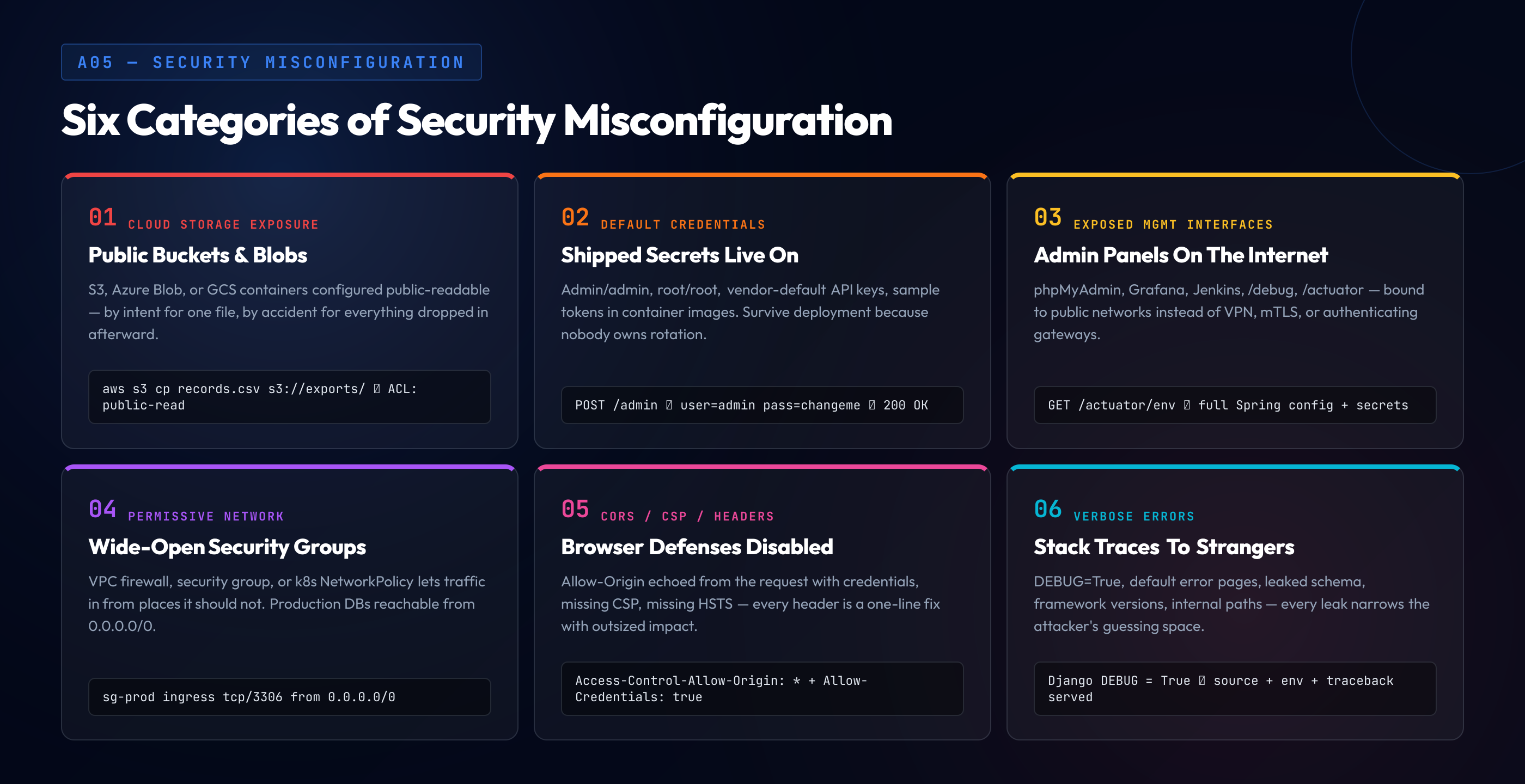
1. Cloud storage exposure. The category that produces the most headlines. An S3 bucket, Azure Blob container, or GCS bucket is configured as public-readable — intentionally, for a specific file that needed to be public, or unintentionally, because the IAM policy was permissive. Every few months, a public data-exposure incident trace back to this pattern: a bucket holding customer records, backup files, credential dumps, or internal documentation that was readable by anyone who knew or guessed the URL. The remediation is straightforward (default-deny with explicit per-file exceptions, bucket policy audit, continuous scanning) and the frequency of the pattern in breach data suggests the remediation is not widely adopted.
2. Default credentials and shipped secrets. A database, admin panel, internal tool, or third-party integration ships with a default username and password. The deployment never changes them. The credential appears in a credential-stuffing attack, a leaked credential database, or a simple guess, and the attacker is inside. In 2026, the category extends to API keys and service tokens that are shipped in documentation, sample code, or container images and inadvertently make it to production.
3. Exposed admin panels, debug endpoints, and management interfaces. A database management panel (phpMyAdmin, Adminer), an application debug interface (/debug, /_status, /admin), a monitoring tool (Grafana, Kibana, Prometheus), or a deployment tool (Jenkins, GitLab) is accessible from the public internet without authentication or with weak authentication. These endpoints are routinely discovered by automated scanners that scan the entire IPv4 space. The remediation is to bind management interfaces to private networks, require VPN or mTLS, or protect them behind authenticating gateways.
4. Permissive network policy. A security group, VPC firewall, or Kubernetes network policy allows traffic from sources that should not have access. The archetype is the "0.0.0.0/0 inbound on port 3306" security group that exposes a production database directly to the internet, but the category extends to overly permissive east-west rules inside a VPC, overly broad egress that enables command-and-control communication, and SaaS API allowlists that include too many IP ranges.
5. CORS, CSP, and security header misconfiguration. HTTP response headers that control cross-origin behavior and client-side security are either missing or set to permissive values. A CORS policy that returns Access-Control-Allow-Origin: * with Access-Control-Allow-Credentials: true enables cross-site data theft. A missing or permissive Content-Security-Policy allows inline scripts and external resource loading that CSP would have blocked. A missing Strict-Transport-Security header leaves users exposed to TLS downgrade attacks. Each of these is a one-line configuration change with outsized security impact.
6. Verbose error handling and information leakage. Application errors return stack traces, database schema information, internal file paths, or framework version details to the user. Each leak narrows the attacker's guessing space. A stack trace that identifies the framework version lets the attacker look up the framework's known CVEs; a database error that includes a table name lets the attacker craft a better SQL injection payload; a 404 response that reveals whether a user exists in the database enables username enumeration.
Security Misconfiguration Examples: Real-World Patterns
The formal categories above become more useful when mapped onto concrete code and configuration. The following are security misconfiguration examples drawn from patterns that consistently appear in pentest findings and post-incident reports.
The Django DEBUG = True in production. Django's DEBUG setting, when True, produces detailed error pages that include source code snippets, the full environment variable dictionary, installed app list, and a structured traceback. In production, this setting must be False, and a secret-key-based fallback page served instead. The number of production Django sites still running with DEBUG = True is non-trivial — a 2024 survey of internet-reachable Django instances found the pattern on a material fraction of the sample. The fix is a one-character change; the operational problem is noticing that the setting has been committed to the production config.
The Express stack trace in the default error handler. Node.js with Express, when the env is not explicitly set to production, returns full error stack traces to the client on unhandled errors. The mitigation is to set NODE_ENV=production and provide a custom error handler that returns a generic error message while logging the full trace server-side. The misconfiguration appears frequently because the local-development behavior is useful (seeing the stack trace helps the developer) and the production behavior is identical unless NODE_ENV is explicitly set.
The S3 bucket with ACL: public-read. An S3 bucket created via the AWS Console with "allow public access" checked, because a specific file was meant to be public and the developer did not realize that ACL public-read applies to all objects inserted into the bucket thereafter. The subsequent developer adds a file of customer records to the same bucket; the file is public; the incident is a data exposure report six weeks later when a researcher discovers the bucket. The remediation is to treat S3 Block Public Access as default-on at the account level, and to serve public files through CloudFront with explicit public-readable configuration rather than through a shared-purpose bucket.
The Kubernetes pod running as root with no securityContext. A pod manifest without a securityContext inherits the container's default user, which for many common base images is root. An attacker who achieves code execution inside the pod has root inside the container and can now attack the node, other pods, and the broader cluster depending on how the pod is attached. The remediation is to set runAsNonRoot: true, runAsUser: <non-zero>, and readOnlyRootFilesystem: true as defaults in a pod security policy that the admission controller enforces.
The CORS allow-all with credentials. A backend API sets Access-Control-Allow-Origin dynamically from the request's Origin header, and sets Access-Control-Allow-Credentials: true. This pattern is not equivalent to the explicit wildcard (which the browser blocks in credentialed requests) but has the same effect: any origin can make credentialed cross-origin requests to the API and read the response. The vulnerability enables cross-site data theft for any logged-in user. The remediation is to use an allowlist of specific origins, not an echo of the request origin, and to never combine credentials with a wildcard origin.
The legacy TLS 1.0/1.1 and the weak cipher suites. A load balancer or web server accepts TLS 1.0 or TLS 1.1, or negotiates down to RC4 or 3DES cipher suites. The attacks against these protocols (BEAST, POODLE, Sweet32) are decades old but still effective against servers that accept the protocols and ciphers. The remediation is to configure TLS 1.2+ only with modern AEAD cipher suites, and to enforce HSTS preload to prevent downgrade.
Cloud Misconfiguration: The Modern Frontier
The shift from self-hosted infrastructure to cloud-managed services has rearranged the misconfiguration landscape significantly. The categories that were most important in 2015 — unpatched OS packages, open SSH with weak passwords, outdated Apache — still exist but have been partially displaced by a new set of cloud-specific misconfiguration patterns that traditional secure-coding training does not address.
IAM misconfiguration. Cloud-provider identity and access management (AWS IAM, Azure RBAC, GCP IAM) is the new perimeter. A policy granting s3:* on Resource: * to a general-purpose service account means the service account can read and write every bucket in the account. A policy with sts:AssumeRole on a broad principal pattern means attackers who compromise the principal can escalate into broader privilege. The discipline — least privilege, resource-scoped permissions, explicit deny for sensitive actions, frequent access review — is well-documented and widely under-practiced.
Over-permissive service-to-service auth. In microservice architectures, service-to-service calls often use shared API keys or wide-scope JWTs that grant more access than any individual call requires. An attacker who compromises one service obtains credentials that work against many others. The remediation pattern is workload identity (AWS IRSA, GCP Workload Identity, Azure Workload Identity) plus mTLS with SPIFFE identities plus fine-grained authorization at each service boundary — a significant architectural investment that most organizations only make after an incident.
Container image misconfiguration. A base image ships with packages the application does not need, a non-essential daemon running, or unnecessary capabilities granted. The container running in production has a larger attack surface than the application itself requires. The remediation is to use minimal base images (distroless, Alpine, Wolfi), to scan images for known vulnerabilities in CI, to drop Linux capabilities the workload does not need, and to sign and verify images throughout the pipeline.
Serverless misconfiguration. Lambda functions, Cloud Functions, and Azure Functions have their own configuration surface: execution role permissions, environment-variable secret storage, function URLs without authentication, overly long timeouts that enable denial-of-wallet attacks. A Lambda function with an attached role that has broad S3 or DynamoDB permissions is a privilege-escalation target; the function gets exploited through application-layer injection, and the attacker inherits the full role capability. The remediation is the same least-privilege discipline, applied per-function.
How to Detect Security Misconfiguration in CI/CD
Detecting misconfiguration after deployment is late. The patterns that scale are the ones that catch misconfiguration before it reaches production — in pull requests, in CI pipelines, and in the infrastructure-as-code that describes the cloud footprint.
Infrastructure-as-code scanning. Tools like Checkov, tfsec, KICS, and Terrascan scan Terraform, CloudFormation, Kubernetes, Helm, and Dockerfile definitions for known misconfiguration patterns. Running these scanners in CI on every pull request that touches infrastructure code catches the majority of the categories above at authoring time. The return on this investment is high — the tools are free, the integrations are mature, and the set of well-known misconfiguration patterns they detect is substantial.
Container image scanning. Trivy, Grype, Snyk Container, and Docker Scout scan container images for known CVEs in base images, installed packages, and application dependencies. Running the scan in CI and failing the build on findings above a severity threshold pushes the vulnerability-remediation work left from production to the pull request.
Cloud Security Posture Management (CSPM). Commercial CSPM platforms (Wiz, Prisma Cloud, Orca, Lacework) continuously scan the deployed cloud footprint for misconfiguration, anomaly, and attack-path exposure. The value is in finding the misconfigurations that slipped past CI — configurations that were created through the console, changed in response to an incident, or accumulated as the environment grew. CSPM is the safety net under the shift-left scanning in CI.
Policy-as-code. Frameworks like OPA (Open Policy Agent) and Kyverno express security policy as code that runs in admission controllers, CI pipelines, or runtime. A policy that prevents Kubernetes pods from running as root is enforced by the admission controller rather than detected after deployment — the misconfigured pod never starts. Policy-as-code moves from "find misconfiguration and alert" to "prevent misconfiguration from being applied."
Configuration drift detection. Tools like driftctl and Terraform Cloud's drift detection compare the deployed configuration against the infrastructure-as-code definition and flag changes that happened outside the IaC workflow (someone clicked in the console). Drift is where misconfiguration frequently enters production: the IaC is clean, the deployed state is not.
These detection patterns connect to the broader secure SDLC as Phase 4 (Verification) and Phase 5 (Release) controls — the misconfiguration scanning runs at the same points in the pipeline as SAST and DAST, and the policy-as-code enforcement sits at the boundary between implementation and release. Teams that treat misconfiguration detection as an infrastructure concern disconnected from application security scanning end up with two parallel programs that cover similar risks with different tooling; teams that integrate both into the same pipeline get compound coverage.
The Default Credentials and Secrets Problem
The category deserves its own section because it is responsible for a disproportionate share of incident headlines. Default credentials — or secrets committed to source control — remain a leading entry vector for attackers, and the patterns that cause them are durable across technology changes.
The shipped default. Software that ships with a default admin credential (admin/admin, root/changeme) and relies on the administrator to change it on first login. The historical pattern is that a non-trivial fraction of deployments never change the default, because the person doing the deployment is not the person who will administer the system, or because the credential is shared across a team and nobody takes ownership of changing it. The remediation from the software side is to force a password change on first login, rather than setting a default the administrator has to remember to change.
The committed secret. A developer commits a database connection string, API key, or service credential to a git repository. The repository is public (GitHub public repo, internal-but-wider-than-intended) or becomes public later. The secret is now exposed and has to be rotated. The prevention patterns are well-established: secret scanning in CI (gitleaks, truffleHog, GitHub secret scanning), pre-commit hooks that reject commits with secret patterns, and architectural patterns that eliminate the need to touch secrets in application code (workload identity, cloud-provider-managed secret stores, just-in-time credential issuance).
The environment variable leak. Secrets stored as environment variables are exposed in error pages, dumps, logs, and process lists. The remediation is to use a purpose-built secret store (AWS Secrets Manager, HashiCorp Vault, Azure Key Vault, GCP Secret Manager) with retrieval at runtime and caching with a TTL, rather than environment-variable injection at container start.
The shared secret sprawl. Service-to-service authentication using shared API keys that get copied between services, cached in configuration files, and rarely rotated. A compromise of any service with the key compromises every service that accepts it. The remediation pattern (workload identity + mTLS + fine-grained authorization) requires architectural investment; the interim remediation is aggressive rotation (quarterly or shorter) with automated rotation pipelines so the organizational cost of rotating is small enough to actually happen.
Scanners Find Misconfiguration. Developers Prevent It.
A CSPM tool surfacing an open S3 bucket six hours after it was created is better than discovering it six months later in a breach report — but neither is as good as a developer who would never have written the permissive bucket policy in the first place. SecureCodingHub builds the configuration-aware security fluency that turns misconfiguration from a recurring incident category into something developers catch themselves at authoring time. If you are tired of the misconfiguration report being the same categories quarter after quarter, we would be glad to show you how our program changes the input side of that pipeline.
See the PlatformRemediation: The Engineering Playbook
The categories above map onto a concrete engineering playbook. The pattern is specific to misconfiguration: unlike code-level vulnerabilities where the fix is in the code, misconfiguration remediation lives in process, tooling, and defaults.
Secure defaults. The organization publishes and enforces secure defaults for every resource type: Terraform modules with hardening baked in, Helm charts with non-root securityContext, base container images built from distroless, CI templates with scanning steps included. Developers who reach for the organizational module get the secure configuration automatically; developers who write their own configuration have to justify the deviation. The investment is in the modules; the return is in the hundreds of downstream uses that inherit the hardening.
Pipeline enforcement. Misconfiguration scanning runs in CI on every pull request that touches infrastructure code. Findings above a severity threshold block merge. Findings below the threshold are recorded for later remediation. This is the shift-left pattern applied to configuration, and it produces the largest risk reduction per dollar of tooling investment in the misconfiguration category.
Admission control in production. Policies that prevent misconfigured resources from being deployed run at the cloud-provider admission layer (AWS SCPs, Azure Policy, GCP Organization Policy) or the cluster admission layer (Kyverno, OPA Gatekeeper). The policy denies the deployment of a public S3 bucket, a root-running pod, a security group with 0.0.0.0/0 on 22. The enforcement is at the point of deployment, not at the point of authoring, which means it catches configurations that bypassed the CI scanning.
Continuous configuration scanning. CSPM and equivalent tools scan the deployed configuration continuously, detecting drift, new misconfigurations introduced through the console, and configurations that became misconfigurations after the scanning rules were updated. The scan output is fed into the same ticket-tracking system as other security findings, with owners and SLAs.
Developer training on configuration patterns. The scanners and admission controllers catch the known patterns; what catches the unknown ones is developer fluency with the configuration surface they touch. A developer who understands why the default S3 public access should be blocked, why the pod should not run as root, why CORS allow-credentials plus echo-origin is dangerous, will catch edge cases that the scanners miss. The language-specific training pattern applies here too — generic "configure things securely" training is less effective than training on the specific configuration surface the developer actually works with.
Incident-driven improvement. Every misconfiguration incident — regardless of whether it led to a breach or was caught internally — produces a specific action: the organizational default is updated to prevent that pattern, the scanning rule is added, the policy-as-code is amended, and the training material includes the example. This closes the loop so that the organization learns from its own incidents rather than repeatedly rediscovering the same categories.
Misconfiguration and the Broader Security Program
Security misconfiguration does not exist in isolation. It sits alongside injection (A03), broken access control (A01), authentication failures (A07), and the rest of the OWASP Top 10 as one of the categories a mature program has to cover. The interaction between categories is worth naming: misconfiguration frequently enables or amplifies other vulnerabilities. A verbose error handler turns a blind SQL injection into a trivial SQL injection by leaking schema. A permissive CORS policy turns an XSS into a cross-origin data theft. A broad IAM role turns an SSRF into a full account takeover. The vulnerabilities that are most expensive in aggregate are often not the worst single vulnerability but the interaction between a code-level flaw and a configuration-level flaw that compounds it.
The consequence for secure-coding training is that misconfiguration awareness has to be taught alongside code-level vulnerability awareness rather than as a separate discipline. A developer who catches SQL injection in code review but does not recognize the verbose-error-handler as a multiplier has only half the picture. Training programs that treat misconfiguration as an "infrastructure team problem" miss the interaction, which is where the worst outcomes actually live.
Closing: Misconfiguration Is the Boring Vulnerability That Costs the Most
The academic classification treats security misconfiguration as one of ten OWASP categories, equal in stature to injection, broken access control, and the rest. The operational reality is that misconfiguration is overrepresented in breach statistics relative to its academic ranking. There are more ways to misconfigure a modern system than there are ways to introduce a single-category code vulnerability, the defaults of many components are still permissive, the configuration surface expands with every new managed service, and the remediation relies on organizational discipline rather than developer skill alone.
The organizations that manage misconfiguration well share a small set of practices: they maintain hardened defaults as shared organizational modules, they run infrastructure-as-code scanning in CI with block-on-failure thresholds, they enforce admission control for critical misconfiguration classes in production, they run continuous posture management across the deployed footprint, and they treat every misconfiguration incident as a prompt to update defaults, scanning rules, and training content. None of these practices is novel in 2026; all of them require sustained institutional commitment to maintain.
The reason misconfiguration is, year after year, a leading source of production incidents is not that the detection problem is hard or that the remediation is unclear. It is that the category is boring relative to the code-level vulnerability classes, gets less attention in training curricula, and accumulates slowly enough that no single change feels worth escalating. The organizations that take misconfiguration seriously treat it as the first-class engineering discipline it actually is — and reap the compound benefit of shipping software where the configuration hardening is a property of the pipeline rather than a recurring audit finding.