When a data breach makes headlines, the conversation centers on regulatory fines and stolen records — a bar that only rises with new regimes like the EU Cyber Resilience Act. But the true cost of insecure code runs far deeper than what any incident report captures. It lives in the daily friction of development teams, the slow erosion of customer confidence, and the compounding weight of security debt that quietly reshapes what an organization can and cannot build.
Beyond the Headlines
IBM's annual Cost of a Data Breach report puts the global average at $4.45 million per incident. That number is staggering, but it only tells part of the story. For every breach that makes the news, there are thousands of organizations silently paying the tax of insecure code in ways that never show up in a headline: delayed product launches, abandoned features, engineer burnout, and deals lost during security questionnaires.
The visible costs of a breach — legal fees, regulatory penalties, customer notification — are one-time events. The invisible costs of insecure code are ongoing. They compound daily, and most organizations don't measure them because they've accepted them as the cost of doing business. The framing of what counts as "secure code" in the first place — and where the line between secure and insecure sits in practice — is worth establishing before reading further; see our what is secure code guide for the definition we use throughout this series.
The Developer Velocity Tax
Every vulnerability discovered in production triggers a cascade that disrupts the development cycle. The engineer who wrote the code three months ago must context-switch away from their current feature work, re-familiarize themselves with the vulnerable module, write a fix, get it reviewed, and push it through an emergency deployment pipeline. Research consistently shows that a vulnerability caught in production costs 6 to 30 times more to remediate than one identified during development.
But the dollar cost of the fix itself is only the surface. The deeper damage is to developer flow. Studies on engineering productivity show that it takes an average of 23 minutes to return to deep focus after an interruption. When security hotfixes become a regular occurrence, teams enter a permanent state of reactive firefighting. Feature velocity drops, sprint commitments slip, and the backlog grows — not because the team isn't talented, but because they're constantly paying down yesterday's security shortcuts.
Technical Debt Compounds
All technical debt slows teams down. But security debt is uniquely dangerous because it doesn't just reduce productivity — it exposes the organization to catastrophic, nonlinear risk. A poorly designed authentication module isn't merely inconvenient to refactor; it's a ticking vulnerability that an attacker can exploit at any moment.
What makes security debt especially insidious is how it propagates. Developers learn by reading existing code. When an insecure pattern exists in one service, it gets copy-pasted into the next service, and the next. An unparameterized database query in one module becomes the template for a dozen more. A missing authorization check in one endpoint becomes the norm for an entire API surface. By the time the pattern is recognized as a vulnerability, it has metastasized across the codebase, turning a single fix into a cross-team remediation project.
The Trust Equation
Customer trust operates on a deeply asymmetric curve: it takes years of consistent reliability to build, and a single incident to shatter. A 2024 survey by PwC found that 87% of consumers say they would take their business elsewhere if they felt a company wasn't handling their data responsibly. Trust, once lost, doesn't return on a predictable timeline — and for many customers, it never returns at all.
"Customers don't read your SOC 2 report. They read the headline that says you lost their data. Trust is a one-way door — once you walk through the wrong side, you can't walk back."
For organizations selling into the enterprise, the calculus is even more direct. Buyers increasingly require SOC 2 Type II, ISO 27001, or industry-specific certifications before signing a contract. They send detailed security questionnaires and expect evidence of secure development practices. Companies that can't demonstrate security maturity don't just risk breaches — they lose revenue opportunities they never even knew existed, because they were disqualified before the conversation started.
The Economics of Prevention
The shift-left security model isn't just a philosophy — it's a financial argument backed by decades of data. The cost to address a security issue increases exponentially as it moves through the development lifecycle:
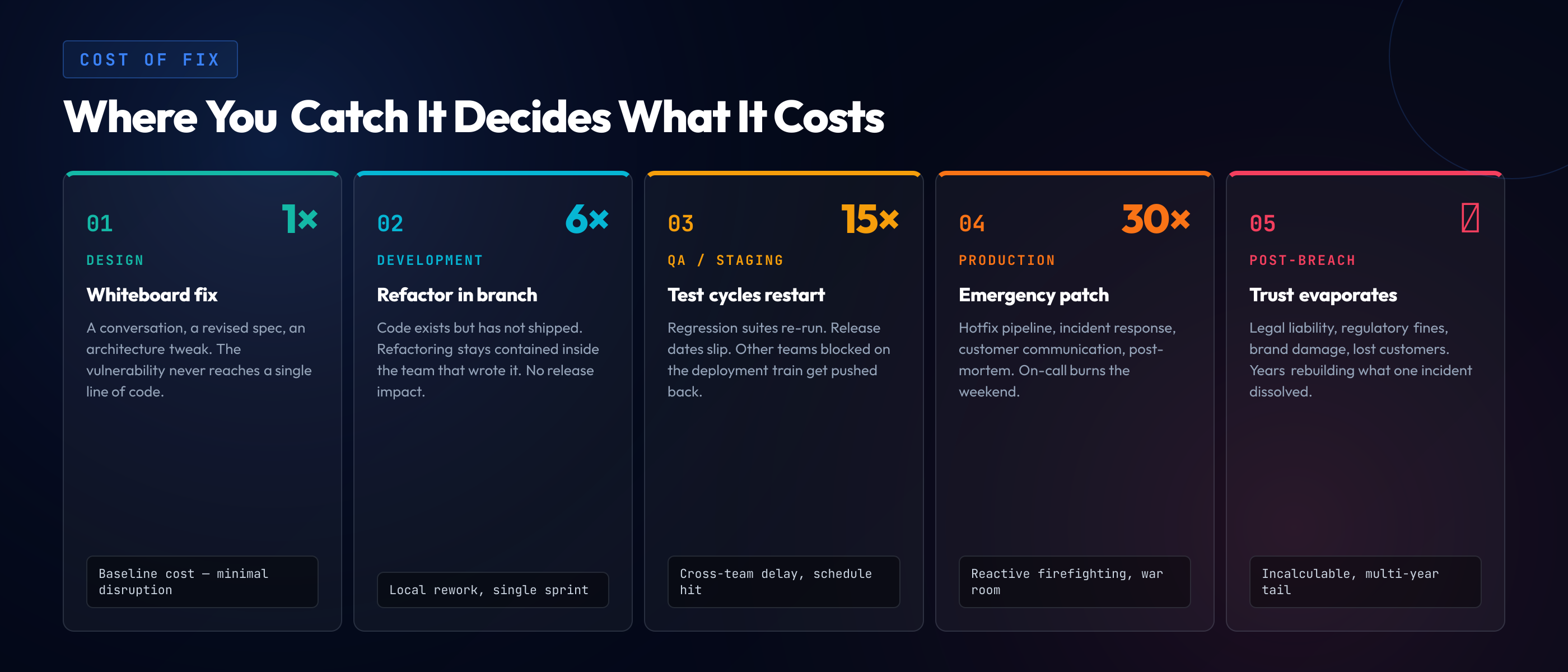
- Cost to fix in design/architecture — $X. A conversation, a whiteboard session, a revised spec. Minimal disruption.
- Cost to fix in development — $6X. The code exists but hasn't shipped. Refactoring is contained to the team that wrote it.
- Cost to fix in QA/staging — $15X. Test cycles restart, release dates shift, and other teams waiting on the deployment are delayed.
- Cost to fix in production — $30X. Emergency patches, incident response, customer communication, and post-mortem analysis.
- Cost after a breach — Incalculable. Legal liability, regulatory fines, brand damage, lost customers, and years of rebuilding trust.
The math is unambiguous. Every dollar invested in catching vulnerabilities earlier saves an order of magnitude downstream. Yet most organizations still allocate the majority of their security budget to detection and response rather than prevention and education.
Investing in Developer Security
The most effective security programs don't treat developers as the problem — they treat them as the solution. When engineers understand why certain patterns are dangerous and can recognize vulnerabilities in context, they write more secure code from the start. The ROI case for proactive developer security training is compelling: fewer vulnerabilities introduced means fewer to find, fewer to fix, and fewer that make it anywhere near production.
Building a security-first engineering culture requires three investments. First, training that mirrors real work — not annual compliance videos, but hands-on practice with the exact vulnerability patterns developers encounter in their codebases. Second, tooling that integrates into existing workflows — static analysis in the IDE, dependency scanning in CI/CD, and security checks in code review that provide actionable feedback without creating alert fatigue. Third, cultural reinforcement — security champions on each team, blameless post-mortems when issues are found, and recognition for engineers who proactively identify and resolve security risks.
The real cost of insecure code is not a single number on an incident report. It's the aggregate of slowed teams, compounding debt, eroded trust, and missed opportunities. The organizations that recognize this — and invest in prevention rather than reaction — don't just avoid breaches. They build faster, ship with confidence, and earn the trust that becomes their competitive advantage.