Most teams searching for a pci dss compliance training program are searching for the wrong thing. The default mental model — "pick a training vendor, assign the modules, collect completion certificates, file under compliance" — was fine for the 3.2.1 era and is dangerous in the 4.0.1 enforcement cycle that began in 2026. The standard now asks for evidence of capability, not evidence of attendance, and most procurement processes have not caught up. This guide is for the team that has been told to "buy PCI training" and has fifteen vendor proposals in front of them, and needs a defensible way to compare what is actually on offer.
Why "Compliance Training" Is the Wrong Frame for 6.2.2
The phrase pci compliance training sets the buying criteria up wrong from the first sentence. The QSA, in 2026, is not auditing whether the organization bought training. The QSA is auditing whether the developers writing code that touches the cardholder data environment can recognize and avoid the attack classes the standard enumerates. A purchase order, an LMS deployment, and a wall of completion certificates satisfy the first reading of the requirement and fail the second — and the second is the one being assessed.
The 4.0.1 text — "personnel are trained... on software security relevant to their job function and development languages, including but not limited to secure software design and secure coding techniques" — describes a capability outcome, not an attendance event. The training is sufficient when the developer can apply it. It is insufficient when the developer cannot, regardless of what the LMS reports.
The criteria that follow from a capability-evidence frame are different. Stack coverage matters because attack classes manifest differently in Java than in Node.js than in Go. Job-function tailoring matters because a backend developer touching the PAN database has different exposure than a frontend developer rendering masked output. Retention and gap-closure measurement matter because a one-shot module that produces a certificate but no behavior change is, by the new reading, no training at all. The full mechanics of what 6.2.2 asks for are covered in our guide to PCI DSS 4.0.1 secure coding training under Requirement 6.2.2.
The 6.2.2 / 12.6.1 Distinction Most Vendors Blur
The single most common product misrepresentation in the pci dss training market is conflating two requirements that look similar from a distance and are different in substance. The vendor that sells "PCI training" as one product is usually selling a package that gestures at both 6.2.2 and 12.6.1, and lands on neither.
Requirement 6.2.2 is developer-specific. Secure coding training, scoped to the languages and frameworks each developer actually uses, covering attack classes relevant to the cardholder data environment, with evidence that each developer received the right curriculum for their job function. Small audience, technical content, depth sufficient to support behavior change in code review and design.
Requirement 12.6.1 is workforce-wide. Security awareness training for all personnel — not just developers — covering current threats, the organization's policies, and the human-layer attack vectors most likely to lead to a CDE compromise. Large audience, general content, depth sufficient to recognize phishing and social engineering. The mechanics are covered in our guide to PCI DSS awareness training under 12.6.1.
A program that covers both with one product covers neither well — the developers get content too generic for 6.2.2's job-function-and-language clause, and the broader workforce gets content too technical for 12.6.1's accessibility expectation. The right buying posture is to evaluate the two as separate procurements, even if the budget is consolidated.
The questions to ask the vendor. "Which requirement does this product satisfy?" "Show me the evidence artifact your product produces for 6.2.2 specifically." "Show me the same artifact for 12.6.1." Vendors with a clear answer have thought about the distinction. Vendors who claim their single product satisfies both have not, and the resulting evidence package will reflect the gap.
The Eight Capabilities a 6.2.2-Qualifying Program Must Provide
Cutting across the marketing categories the pci dss training providers market organizes itself into, there are eight capabilities a developer training program has to provide for the resulting evidence to satisfy a 4.0.1 reading of 6.2.2. Each is something the QSA will check during the assessment cycle. A program missing any one is exposed.
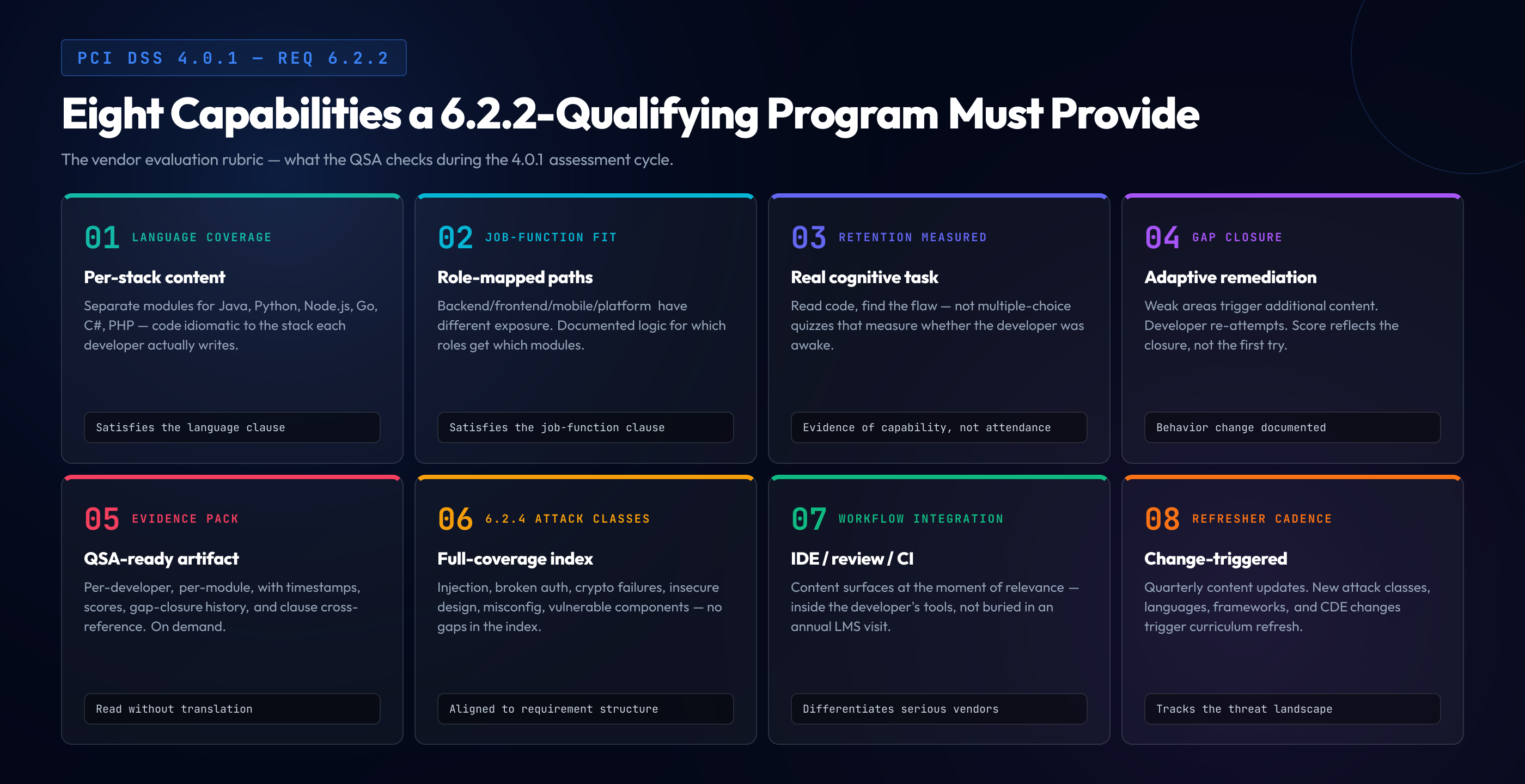
1. Language-specific content. A program that delivers a single "secure coding" track regardless of whether the developer writes Java, Python, Node.js, Go, C#, or PHP does not satisfy the language clause. The right shape is structurally per-language — separate modules for each stack, with code idiomatic to that language.
2. Job-function tailoring. A backend developer touching the payment-processing path needs different content than a mobile developer building a wallet UI than a platform engineer running the cluster the CDE lives in. The right shape is role-mapped curricula with documented logic for which roles get which modules.
3. Retention measurement. A multiple-choice quiz at the end of a video that the developer passes on the first try does not measure retention; it measures whether the developer was awake. The right shape is challenges that exercise the actual cognitive task — read this code, find the vulnerability — with scoring that distinguishes real understanding from a guess. Industry retention rates on quiz-based programs sit in the 15-30% range when measured against the same content six weeks later; hands-on programs measure materially higher.
4. Gap closure. Measurement is necessary but insufficient. A developer who fails the SQL injection challenge needs a path back to the relevant content, not just a red mark in the LMS. The right shape is adaptive: weak areas trigger additional content, the developer re-attempts, the score reflects the closure.
5. Evidence pack production. The QSA's check is "show me the evidence". The evidence pack — per-developer, per-module, with timestamps, completion status, score history, gap-closure record, and a mapping from modules to the requirement clauses they satisfy — has to be producible on demand in a format the assessor reads without translation. A CSV export from an LMS dashboard is raw material, not evidence.
6. Attack-class coverage matching 6.2.4. Requirement 6.2.4 enumerates the attack classes developers must be trained against — injection, broken authentication, cryptographic failures, insecure design, security misconfiguration, vulnerable components, and so on. A 6.2.2 program whose module index cannot be cross-referenced against the 6.2.4 list with no gaps is not aligned to the requirement structure.
7. Integration with developer workflow. A platform that lives in an LMS the developer visits once a year does not produce the behavior-change evidence the 4.0.1 reading expects. The right shape is a program that integrates with the tools the developer uses — IDE, code review, the CI pipeline — so the content surfaces at the moment of relevance. The integration story is the criterion most likely to differentiate a serious vendor from a compliance-video vendor.
8. Change-trigger refresher cycle. The standard's cadence is annual at minimum, but training has to refresh when the threat landscape changes — new attack classes, new languages, new framework versions, new CDE architecture. The vendor's content update cadence is a fair evaluation question: quarterly is a reasonable bar; annual lags the threat landscape.
Off-the-Shelf Compliance Training: What It Actually Is
The category of compliance training for developers products that has dominated the market since the 3.2.1 era is built around a specific deliverable shape. Generic videos narrated by an instructor, covering broad security concepts with stock illustrations. Multiple-choice quizzes with three or four options and one obviously correct answer. A certificate of completion the LMS issues when the quiz is passed. A dashboard the compliance team exports to demonstrate "100% of developers completed PCI training this cycle".
The shape was designed to satisfy the 3.2.1 reading. 2026 is the year the calculus shifts. The 4.0.1 frame asks the QSA to evaluate whether the training produced developers who can recognize attack classes in code, and the assessor's evidence check is increasingly skeptical of completion-certificate evidence in isolation. The pattern most likely to produce a finding is a program where the LMS reports 100% completion but the assessor's spot-checks — asking a developer to walk through a recent secure code review, asking another to point to where SSRF was covered — produce blank looks. The blank looks are the finding.
Off-the-shelf compliance video still has a place — typically as the workforce-wide 12.6.1 awareness layer. It is not, in the 4.0.1 reading, a sufficient answer to 6.2.2's developer-specific clause. The traditional shape and why it underperforms the new requirement is covered in more depth in why traditional security training fails.
Hands-On / Code-Based Training: The Standard for 2026
The category of secure coding training vendors that has emerged to address the gap is structured differently. Instead of video-and-quiz, the deliverable is interactive: vulnerable code review exercises where the developer reads real code in their own language and identifies the flaw, fix-the-vulnerability exercises where the developer rewrites the vulnerable block and the platform validates the fix, in-browser sandboxes that match the developer's actual stack. The pedagogical claim is that secure coding is a skill, and skills are acquired by doing.
The capability-evidence advantage is direct. A developer who has fixed a SQL injection in Java with parameterized queries — in a sandbox, against a working application, with the fix validated — has acquired a transferable skill in a way that watching a video does not produce. Hands-on programs typically measure retention two to three times higher than quiz-based programs on equivalent content, and the gap is most pronounced on the attack classes that require pattern-matching against unfamiliar code.
The shape also produces better evidence artifacts. The developer's score on a hands-on challenge is not "answered the multiple-choice question correctly"; it is "found the vulnerability in this code block, applied the correct fix, the fix passed validation". That artifact is closer to the capability-evidence the 4.0.1 reading expects.
The trade-offs are real. Hands-on programs cost more per seat, require more developer time, and demand more content engineering from the vendor. The 2026 buying decision is whether to pay the higher per-seat cost for a program that satisfies 6.2.2's capability-evidence frame, or pay less for a program that produces evidence the assessor is increasingly skeptical of. Organizations whose risk tolerance does not allow a finding are converging on the hands-on shape.
The Vendor Comparison Matrix
The practical evaluation is structurally the same regardless of which vendors are in the shortlist. The matrix below is a working template — fill in the vendor names across the top, score each row honestly, and the comparison resolves itself.
- Content depth — language coverage. Is the content language-specific (idiomatic code in each language) or language-flavored (the same content with variable names changed)? Pick a language your team uses and ask the vendor to demonstrate three challenges in it. The depth is visible immediately.
- Content depth — attack class coverage. Does the content library cover the full 6.2.4 attack class list? When was the SSRF content last updated, the deserialization content, the supply-chain content?
- Pedagogical model. Video-and-quiz, hands-on challenge, mixed? What is the platform doing during the challenge — passive observation or active validation of the developer's work?
- Job-function tailoring. Is there a documented mapping of role to curriculum? How granular — backend/frontend, or backend/frontend/mobile/platform/data? Can it be customized for the organization's role taxonomy?
- Evidence and reporting. Is there a QSA-ready evidence pack, or is the evidence raw material the compliance team has to assemble? Ask for a sample export.
- Integration with developer workflow. IDE, code review, CI pipeline — or does it live entirely in the LMS? Ask for a demo of the integration, not a slide about it.
- Cost model. Per-seat annual, per-developer per-cycle, organization-wide flat fee? What is in the base price versus separately priced add-ons? What does year-over-year pricing look like?
- Customer profile. Who else in your industry segment has bought this? Vendors whose customer base is concentrated in compliance-driven sectors with active QSA engagement have content shaped by that feedback.
- Update cadence. How often is the content library updated? What triggers an update — calendar, new attack-class disclosure, customer request?
- Pilot availability. Will the vendor support a 4-week pilot with 10-20 developers, with the evidence pack produced and reviewable at the end?
Score each row across the shortlisted [Vendor] options. The program that scores well across content depth, evidence production, integration, and pilot availability is the program most likely to produce the capability-evidence the 4.0.1 cycle expects. The program that scores well only on cost-per-seat is the program whose marketing has done its job and whose product has not.
Total Cost of Ownership: Training Spend vs Compliance Cost vs Breach Risk
The training procurement line item — typically low five figures for a small engineering team, mid-five figures for a mid-sized team, low six figures for a large enterprise with multiple stacks — does not stand alone in the cost calculus. The right comparison is against the cost of getting the requirement wrong, in two layers: non-compliance cost (monthly fines, card brand assessments, breach exposure) and remediation cost when a finding appears.
The full mechanics of the non-compliance cost surface are covered in our guide to what PCI non-compliance actually costs. The headline is that even the introductory tier of acquiring-bank monthly fines exceeds the annual cost of a serious 6.2.2-qualifying training program after three to six months of non-compliance, and the breach-driven cost layers exceed it by orders of magnitude.
The TCO comparison most procurement processes get wrong treats "cheaper training" and "more expensive training" as the only two variables. The third — the probability-weighted cost of the finding the cheaper training produces — is rarely modeled and is, by an order of magnitude, the largest line in the calculation. A program that costs $40,000 more annually but produces evidence that holds up to QSA scrutiny is, in expected-value terms, dramatically less expensive.
The CFO who reads the TCO correctly does not see PCI training as a procurement line item; they see it as the cheapest insurance against a known cost surface.
Buying Process: Pilot, Evidence, QSA Validation
The highest-leverage move in a pci compliance certification training procurement is to refuse the "buy first, deploy, see how it goes" path most vendors prefer and replace it with a structured pilot. A vendor pushing back on a pilot is a vendor whose product does not perform well under observation.
The 4-week pilot, 10-20 developers. Select a representative cross-section — backend, frontend, mobile, platform, mid-level and senior — and run them through the full curriculum the vendor proposes for their roles. Four weeks is enough to surface the curriculum's depth, the platform's UX, the integration's completeness, and the evidence pack's shape.
The evidence pack review. At the end of the pilot, ask for the full evidence pack the pilot produces. Review it with the eye the QSA will read it with. Does it map per-developer to per-module? Does it cross-reference to the requirement clauses each module satisfies? Does it match the format the QSA requested in the prior cycle's RoC? An evidence pack the compliance team has to substantially rework before the QSA sees it is one the platform did not produce.
The QSA pre-validation conversation. Before signing the full procurement, walk the evidence pack through the QSA who will perform the actual assessment. Ask directly: "Would this evidence pack satisfy your 6.2.2 evaluation? What would you want to see added or restructured?" The QSA's feedback is the most reliable signal in the entire evaluation.
The retention check at six weeks. The pilot's most useful diagnostic is not what developers score during the four-week window; it is what they score on the same challenges six weeks later, with no intervening review. The hands-on vs quiz-based delta is most visible here.
The Eight Capabilities Above Are the SecureCodingHub Product Spec
Our PCI DSS training program was built against the same eight capabilities the buyer's guide above describes — language-specific content across the major stacks, role-mapped curricula, hands-on challenges with retention measurement and adaptive gap closure, attack-class coverage matching 6.2.4, IDE and code-review integration, change-triggered refresher cycles, and a QSA-ready evidence pack the assessor reads without translation. If the criteria above match what your procurement is looking for, the demo is the fastest way to see whether the product matches the criteria. We are happy to structure a 4-week pilot with 10-20 of your developers and produce the full evidence pack at the end, on the same terms this guide recommends.
See a DemoClosing: The Question to Walk Into Every Vendor Demo With
Every pci dss training program demo will spend its first thirty minutes on a feature tour — the LMS UI, the content library, the dashboard. The features are real but they are not the question. The question, which the buyer should ask in the first five minutes and re-ask if the answer is evasive, is this: show me the per-developer evidence pack your product produces, in the format my QSA will read it, with the requirement clauses cross-referenced and the gap-closure cycle documented, for a developer who has completed the curriculum you propose for my organization.
The answer is either a clean artifact, produced quickly, in the right shape — or it is hand-waving, qualifications, "well, we generate the raw data and your team assembles it", or a polite redirect back to the feature tour. The first answer means the vendor has built their product against the capability-evidence frame the 4.0.1 cycle expects. The second means they have built it against the completion-certificate frame the 3.2.1 cycle accepted and are trying to sell the same product into the new requirement landscape.
The procurement decision, read at the right level of abstraction, is not "which training vendor" but "which evidence-production system, of which the training content is one component". The 2026 cycle has tightened the assessor's reading of 6.2.2 enough that the evidence pack is the entire deliverable, and a program that does not produce a defensible one is a program that produces a finding. The buyer's job is to ask the question clearly enough that the answer is unambiguous, and then to act on what they hear.