Every developer who has ever opened a SAST report, a bug bounty triage thread, or an NVD entry has seen a string that looks like CWE-79 or CWE-89. Most teams treat the identifier as background noise — a tag the scanner attaches to a finding before they get to the line of code that actually broke. But cwes are the shared vocabulary the entire application security industry uses to talk about bug classes, and a developer who can read a CWE entry fluently extracts more out of every scanner finding, every CVE advisory, and every code-review conversation than one who treats the ID as opaque. This guide is the developer-oriented introduction: what is a cwe, how the Common Weakness Enumeration relates to CVE, how a CWE entry is structured, what the CWE Top 25 actually represents, how CWE maps to the OWASP Top 10, where CWE IDs surface in real engineering workflows, how to read a CWE entry as a developer, what "CWE-compatible" tooling claims actually mean, the misconceptions that produce wasted effort, and the closing reminder that CWE is the lingua franca that lets security, dev, and compliance speak about the same bug without talking past each other.
What Is a CWE? Common Weakness Enumeration Defined
The Common Weakness Enumeration is a community-maintained, hierarchical catalogue of software and hardware weakness types — patterns of code, design, and architecture that, when present in a system, can be exploited to violate a security guarantee. CWE is hosted and curated by MITRE, the same not-for-profit organization that runs the CVE program, and the catalogue is published openly at cwe.mitre.org. Each entry has a stable numeric ID (the cwe id) prefixed with CWE-: CWE-79 is cross-site scripting, CWE-89 is SQL injection, CWE-787 is out-of-bounds write, CWE-22 is path traversal. The IDs do not change. An entry that existed in CWE 1.0 in 2006 has the same number today, even after fifteen-plus revisions of the catalogue.
The first thing to understand about cwes is that CWE is a taxonomy of weakness classes, not a list of specific vulnerabilities. CWE-79 is "Improper Neutralization of Input During Web Page Generation (Cross-site Scripting)" — the class of bug. The specific XSS vulnerability you found last Tuesday on your application's search page is not CWE-79 itself; it is an instance of CWE-79. The distinction is the same one you would make between "the concept of a null pointer dereference" and "this specific null pointer dereference at line 412 of payment_service.rs." CWE catalogues the classes; CVE catalogues the instances; the two work together as separate registries serving different purposes.
The second thing to understand is that the catalogue is structured, not flat. There are around 940 CWE entries as of CWE 4.16 (the version current at the time of writing), and they are organized into a hierarchy with multiple abstraction levels: pillars, classes, base weaknesses, variants, and compound weaknesses. CWE-707 ("Improper Neutralization") is a class-level entry that sits above CWE-74 ("Improper Neutralization of Special Elements in Output Used by a Downstream Component (Injection)"), which itself sits above CWE-79 (XSS), CWE-89 (SQL injection), CWE-78 (OS command injection), CWE-90 (LDAP injection), and the rest of the injection family. A finding can be tagged at the most specific level the analyst can determine; a SAST tool that can prove the sink is an HTML page will tag CWE-79; one that only knows the sink is "some interpreter" might tag CWE-74.
The third thing to understand is that CWE describes weaknesses, not severities. A CWE entry says "here is a class of bug, here is what it looks like in code, here is how to fix it." It does not say "this bug is severe" or "this bug is critical." Severity is a property of a specific vulnerability instance in a specific deployed system — it depends on what the affected component does, what data it touches, what the blast radius is, and what attacker capability is required. Severity scoring lives in CVSS; weakness classification lives in CWE; the two are orthogonal, and conflating them is one of the most common mistakes teams make when triaging scanner output.
CWE vs CVE — Bug Class vs Bug Instance
The cwe vs cve distinction is the single most important framing in this guide, and the one that resolves the largest amount of confusion across security/dev/compliance conversations. CVE — Common Vulnerabilities and Exposures — is a catalogue of specific, identified vulnerabilities in specific products and versions. CWE is a catalogue of bug classes that those vulnerabilities are instances of. CVE entries reference CWE entries; CWE entries do not reference CVE entries. The relationship is one-to-many in the obvious direction — many CVEs share a single CWE — and many-to-one in some cases too, because a complex vulnerability can implicate more than one weakness.
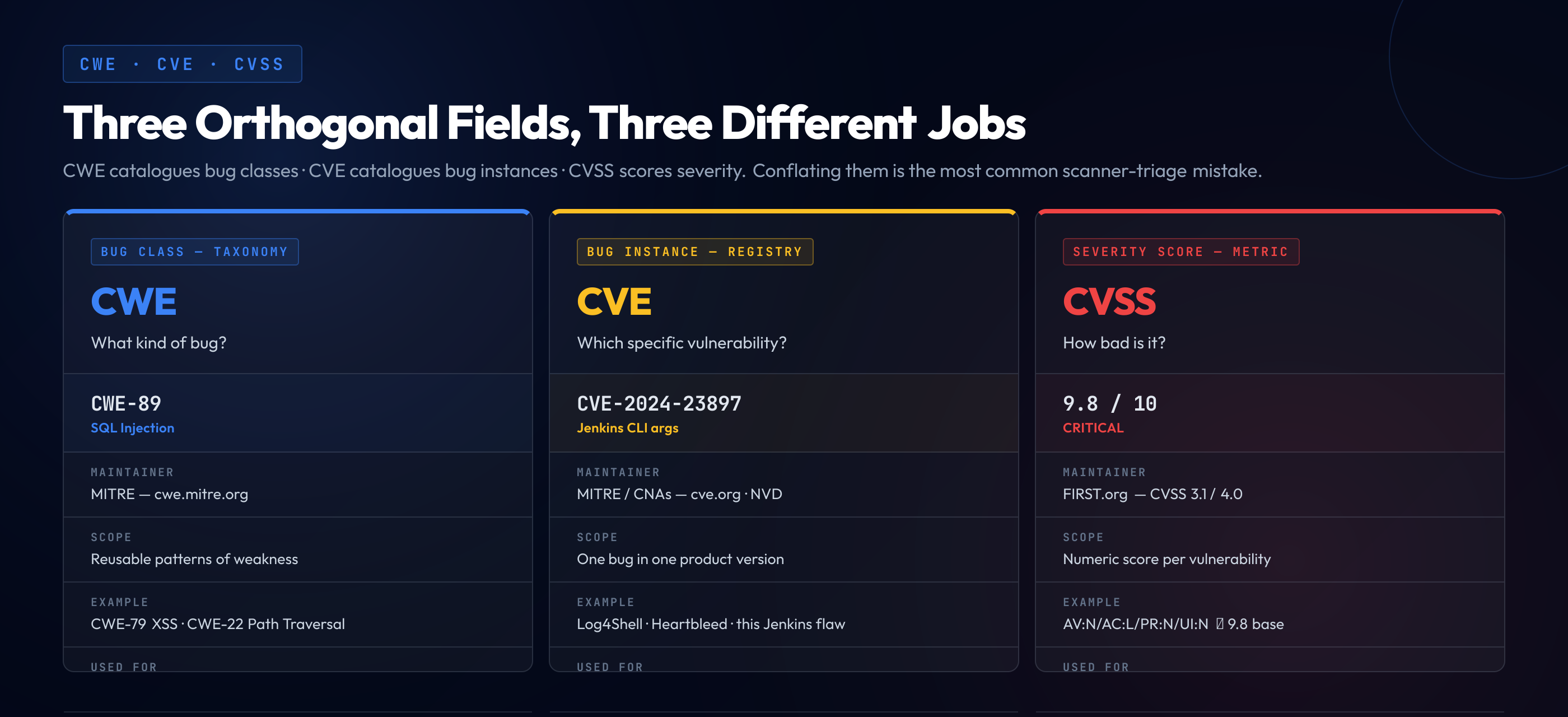
A concrete example makes the distinction tangible. CVE-2024-23897 is the well-known Jenkins CLI argument-parsing vulnerability disclosed in January 2024, which let an unauthenticated attacker read arbitrary files from the Jenkins controller through a crafted CLI command. The NVD entry for that CVE tags it with CWE-77 ("Improper Neutralization of Special Elements used in a Command (Command Injection)") and CWE-200 ("Exposure of Sensitive Information to an Unauthorized Actor"). The CWE entries describe the bug classes — command injection, information exposure — that this specific Jenkins bug instantiates. A different CVE, in a completely different product, might tag the same CWEs because it is a different instance of the same classes. The CVE is the where-and-when; the CWE is the what-pattern.
The mapping flows naturally in real artifacts. An NVD record for a CVE looks roughly like this when you fetch it:
{
  "cve": {
    "id": "CVE-2024-23897",
    "descriptions": [{
      "lang": "en",
      "value": "Jenkins 2.441 and earlier... allows attackers to read..."
    }],
    "weaknesses": [{
      "source": "nvd@nist.gov",
      "type": "Primary",
      "description": [
        { "lang": "en", "value": "CWE-77" }
      ]
    }],
    "metrics": {
      "cvssMetricV31": [{
        "cvssData": { "baseScore": 9.8, "baseSeverity": "CRITICAL" }
      }]
    }
  }
}
The CVE is the identifier. The CWE is the bug class — populated as a list because some CVEs map to multiple weaknesses. The CVSS score is the severity. Three orthogonal fields, three different jobs. A team reading this record sees: "here is a specific Jenkins vulnerability (CVE), in the command-injection class (CWE), with critical severity (CVSS)." Each field answers a different question, and the value of CWE specifically is that it lets you reason about the kind of bug, which lets you generalize to "do we have any other code paths exposed to the same weakness."
This is also the framing that explains why MITRE runs both registries. CVE answers "what specific vulnerabilities exist that we need to patch in our deployment." CWE answers "what classes of bugs exist that we need to build defenses against in our codebase." A patch-management program runs primarily on CVE feeds. A secure-development program runs primarily on CWE understanding. Both programs need both registries, but they consume them in different rhythms, and the frequent confusion in the industry comes from teams trying to make CVE answer questions only CWE can answer (or vice versa).
How a CWE Entry Is Structured
Every CWE entry follows the same structural template, which is itself defined in a CWE schema (XSD, published alongside the catalogue). Once you know the template, every entry — across all 940 — becomes readable in roughly the same way. Walking through CWE-89 ("Improper Neutralization of Special Elements used in an SQL Command (SQL Injection)") makes the template concrete.
Identifier and abstraction level. The top of a CWE entry shows the ID (CWE-89), the entry name (improper neutralization of special elements used in an SQL command), and the abstraction level. Abstraction levels are pillar (the highest, broadest category — there are about ten of these, e.g., CWE-664 "Improper Control of a Resource Through its Lifetime"), class (a still-broad category like CWE-74 Injection), base (a specific weakness like CWE-89 SQL Injection), variant (a more specific instantiation like CWE-564 "SQL Injection: Hibernate"), and compound (a weakness composed of multiple primary weaknesses). Most CWEs you encounter in tool output are base-level — the abstraction sweet spot for talking about bugs concretely without overspecifying.
Description and extended description. A short paragraph defining the weakness, followed by a longer extended description that provides context, motivation, and clarifying notes. The descriptions are the part most readers go to first, and they are written for engineers — concrete, with examples of language and technology where the weakness appears.
Relationships. Every CWE entry has a "Relationships" section that lists how the entry connects to other CWEs: parents (more abstract weaknesses that this one is a child of), children (more specific weaknesses), peers, and "CanPrecede"/"CanFollow" relationships that capture causal chains. CWE-89 has CWE-943 ("Improper Neutralization of Special Elements in Data Query Logic") as a parent and several Hibernate/JPA-specific variants as children. The relationship graph is what makes CWE a true taxonomy rather than a flat list — you can navigate up to the more general weakness or down to the more specific one depending on what level of granularity your conversation needs.
Modes of introduction. A CWE entry lists the SDLC phases at which the weakness typically gets introduced — architecture/design, implementation, build/compilation, operation. CWE-89 is overwhelmingly an implementation-phase weakness; CWE-269 ("Improper Privilege Management") is more often architecture/design. The phase tagging connects CWE to the lifecycle conversation we cover in our secure SDLC from requirements to deployment guide — different phases need different controls.
Applicable platforms and common consequences. Languages, technologies, and architectures where the weakness appears, and the security properties commonly violated when it is exploited (confidentiality, integrity, availability, accountability). CWE-89 lists every major language with a SQL driver and lists "Read Application Data" and "Modify Application Data" as the primary consequences.
Demonstrative examples. Snippets of vulnerable code in concrete languages, paired with the explanation of why the snippet is vulnerable and how an exploit would proceed. CWE-89 demonstrates with PHP/MySQL string concatenation, Java/JDBC Statement usage, and a Perl DBI example. The demonstrative examples are the reason developers can read CWE entries directly — they look like code, not like compliance documents.
Detection methods. A list of how the weakness can be found: manual code review, automated static analysis (SAST), dynamic analysis (DAST), fuzzing, formal methods, etc. Each method is rated for effectiveness against the weakness. CWE-89 lists SAST as "High" effectiveness because the source-to-sink pattern is well-known and reliably matched; CWE-862 ("Missing Authorization") lists SAST as "Limited" because authorization weaknesses depend on context the scanner usually cannot infer. The detection-methods section is one of the most useful for engineering teams choosing where to invest tooling — see our IAST vs DAST vs SAST comparison guide for how the categories map onto real-world tooling tradeoffs.
Potential mitigations. A list of architectural, design, and implementation-level mitigations, each tagged with the SDLC phase it applies to and an effectiveness rating. CWE-89's mitigations include parameterized queries (high effectiveness, implementation phase), least privilege for database accounts (defense-in-depth, architecture phase), input validation as defense-in-depth (limited effectiveness alone). The mitigations are the section developers reach for when fixing a finding — and the section that explains why "input validation" is consistently ranked below "parameterized queries" for SQL injection.
Memberships. Lists of curated views the entry belongs to: the CWE Top 25, OWASP Top 10 mappings, "Weaknesses for Simplified Mapping of Published Vulnerabilities," and various research and education views. Memberships are how MITRE curates subsets of CWE for specific audiences — the CWE Top 25 is one such view; another is the CWE/SANS Top 25 historical lists; another is mappings to specific compliance frameworks.
Once you can navigate all eight sections of an entry, you can read any CWE in roughly two minutes and extract the relevant information for whatever conversation you are having — whether that is "what is this scanner finding," "how do I fix this," or "what other code in our system is at risk of the same class."
The CWE Top 25 — What It Is and How MITRE Compiles It
The cwe top 25 — formally "CWE Top 25 Most Dangerous Software Weaknesses" — is an annually published ranking of the 25 weakness classes responsible for the highest combined volume and severity of vulnerabilities disclosed in the previous calendar year. The list is published by MITRE in collaboration with the Homeland Security Systems Engineering and Development Institute (HSSEDI) and CISA. It is the closest CWE analog to the OWASP Top 10, but its compilation methodology and intended audience are different in important ways.
The compilation method is data-driven. MITRE pulls the CVE records published in the prior calendar year, looks up the CWE mapping for each CVE in NVD, computes a score for each CWE that combines frequency (how many CVEs were tagged with it) and severity (the average CVSS score of those CVEs), and ranks the 25 highest-scoring CWEs. The exact formula has been refined over the years — it currently weights frequency and severity together using a normalized scoring model — but the principle is consistent: the CWE Top 25 reflects what was actually exploited, disclosed, and recorded in the prior year, not what a panel of experts believes is most important. This is a meaningful distinction from the OWASP Top 10, which historically has incorporated significant survey-based input from practitioners alongside data.
The 2023 CWE Top 25 (published in 2024, the most recent finalized version at this writing) opened with familiar entries: CWE-787 (out-of-bounds write) at #1, CWE-79 (XSS) at #2, CWE-89 (SQL injection) at #3, CWE-416 (use after free), CWE-78 (OS command injection), CWE-20 (improper input validation), CWE-125 (out-of-bounds read), CWE-22 (path traversal), CWE-352 (CSRF), CWE-434 (unrestricted file upload). The rankings shuffle year over year, but the same handful of weaknesses dominate consistently — the memory-safety weaknesses (787, 416, 125) reflecting the persistent C/C++ codebase volume in scanned and disclosed software, and the web-injection weaknesses (79, 89, 78) reflecting the scale of the web application surface. The full year-over-year movement is detailed at cwe.mitre.org and is worth reading once a year as the industry's annual scoreboard for which bug classes shipped most.
The Top 25 is intended primarily as a prioritization aid for security programs. If you are a vendor building a SAST tool, your default ruleset should cover the Top 25 with high coverage; if you are a security team building a code-review checklist, the Top 25 is a reasonable starting point for which weaknesses your reviewers must recognize fluently. The Top 25 is not, however, a complete list of weaknesses developers should care about. Weaknesses 26-940 in the catalogue are not "less important" — they appear less frequently in CVE feeds, often because they affect smaller user bases or because the products implementing them have less external scrutiny. A specialized product might have weaknesses outside the Top 25 that are critical for its specific surface; the Top 25 is a population-level statistic, not a per-codebase prescription.
CWE vs OWASP Top 10 — Different Lists, Different Purposes
The CWE Top 25 and the OWASP Top 10 are easy to confuse — both are annually-or-periodically-updated rankings of important security weaknesses, both are used by vendors as marketing-friendly references, and both contain overlapping entries. But the two lists differ in scope, methodology, and audience in ways that matter when you are deciding which one to anchor a program on.
OWASP Top 10 is web-application-specific. It explicitly targets risks to web applications and APIs, with category names that are framed in web terms (Broken Access Control, Cryptographic Failures, Injection, Insecure Design, Security Misconfiguration, Vulnerable and Outdated Components, Identification and Authentication Failures, Software and Data Integrity Failures, Security Logging and Monitoring Failures, SSRF). The list is updated every three or four years rather than annually, and the methodology combines disclosed-vulnerability data with practitioner survey input to produce the rankings. A full breakdown of the rankings and their changes is in our OWASP Top 10 2025 changes overview.
CWE Top 25 is software-and-hardware-general. It includes weaknesses that have nothing to do with web — CWE-787 (out-of-bounds write) and CWE-416 (use after free) are memory-safety weaknesses dominant in C/C++ system software, not web applications. The methodology is purely data-driven (frequency-weighted CVSS over CVE feeds), updated annually. The audience is anyone shipping software — vendors, OEMs, embedded systems, kernel developers — not just web teams.
The two lists overlap because the web-application weaknesses dominant in OWASP also appear in CWE — the same web bugs are getting CVEs filed against them. But the relationship is one of CWE-as-vocabulary and OWASP-as-curated-view: each OWASP Top 10 category maps to one or more CWEs. Specifically:
OWASP A01 (Broken Access Control) maps to CWE-285, CWE-862, CWE-863, CWE-639, CWE-22, CWE-352 and others — broken authorization, missing authorization, incorrect authorization, authorization bypass through user-controlled key, path traversal (which is a special case of access-control failure on filesystem resources), and CSRF. OWASP A02 (Cryptographic Failures) maps to CWE-327 (broken/risky crypto algorithm), CWE-326 (inadequate encryption strength), CWE-310 (cryptographic issues, parent class), CWE-330 (insufficient randomness), CWE-798 (hardcoded credentials). OWASP A03 (Injection) — covered in our OWASP A03 injection developer guide — maps to CWE-89 (SQL injection), CWE-79 (XSS, since 2021's absorption), CWE-78 (OS command injection), CWE-90 (LDAP injection), CWE-94 (code injection), CWE-77 (command injection generic). OWASP A04 (Insecure Design) maps loosely — it is a framing-level category rather than a tight CWE family. OWASP A05 (Security Misconfiguration) covers CWE-16 (configuration), CWE-2 (environmental security flaws), CWE-732 (incorrect permission assignment for critical resource), and the rest of the misconfig class.
The right way to think about the two lists together is: OWASP Top 10 gives you a curated, memorable framing of the top web-application risks, written for executives, auditors, and product owners; CWE Top 25 gives you a data-driven, software-general weakness ranking, written for security engineers, tool vendors, and curriculum designers. A team running a web application benefits from both — OWASP for stakeholder communication and roadmap framing, CWE for tooling configuration and developer reference.
CWE in Real Workflows — Where the IDs Surface
Once you know what CWE IDs mean, you start noticing them everywhere in real engineering and security workflows. This section walks through the four most common surfaces where developers encounter CWE in 2026.
SAST output. Every modern static analysis tool tags its findings with CWE IDs. CodeQL, Semgrep, Snyk Code, SonarQube, Checkmarx, Veracode, Fortify, GitHub code scanning — all of them produce findings with a CWE ID attached. A typical SAST report line in a CI log looks something like this:
[snyk] High severity vulnerability found in src/handlers/search.js
  Type: Cross-site Scripting (XSS) [CWE-79]
  Path: src/handlers/search.js, line 47, column 23
  Issue: Unsanitized input from req.query.q flows into res.send,
         where it is executed as code in an HTML context.
  Fix: Apply context-aware output encoding, or use a templating
       engine that auto-escapes interpolated values.
The CWE-79 tag tells you the bug class. The location tells you where. The fix advice ties back to the "Potential Mitigations" section of the CWE-79 entry. A developer who has read CWE-79 once already knows that "context-aware output encoding" means the same five HTML special characters and that templating-engine auto-escape is the standard primary mitigation. The CWE ID is what makes the scanner output legible without re-explaining XSS from scratch in every finding.
NVD and CVE records. Every CVE record in the National Vulnerability Database has a CWE field linking the vulnerability to its weakness class. When you read a CVE advisory — for a dependency you use, a base image you ship, a piece of infrastructure software — the CWE tells you what kind of bug you are dealing with, which informs where you go look for similar issues in your own code. A CVE tagged CWE-502 (deserialization of untrusted data) on a library you use is a prompt to audit your codebase for the same pattern in case you have parallel exposure.
Bug bounty reports and security advisories. HackerOne, Bugcrowd, Intigriti, and GitHub Security Advisories all use CWE IDs as a standard tagging field. When a researcher submits an XSS report on HackerOne, the report is filed under CWE-79; when a researcher submits a path-traversal report, it goes under CWE-22. The tagging lets program owners filter and prioritize: "show me all our open CWE-89 reports" is a one-click filter on a HackerOne dashboard. A GitHub Security Advisory looks roughly like this in its raw form:
{
  "ghsa_id": "GHSA-xxxx-yyyy-zzzz",
  "summary": "Path Traversal in @example/file-server",
  "description": "The library accepts a user-controlled path...",
  "cwes": [
    { "cwe_id": "CWE-22", "name": "Improper Limitation of a Pathname..." }
  ],
  "severity": "high",
  "cvss": { "score": 8.1, "vector_string": "CVSS:3.1/AV:N/AC:L/..." }
}
Code review and triage. Teams that have invested in security fluency talk about findings using CWE IDs in PR review. "This new endpoint introduces a CWE-918 SSRF risk because it fetches arbitrary URLs from a request parameter" is much shorter and more precise than describing the same finding in plain English. A code reviewer who can name CWE-352 (CSRF), CWE-918 (SSRF), CWE-611 (XXE), CWE-863 (incorrect authorization), CWE-269 (improper privilege management) by ID can refer to standard mitigations efficiently and without having to re-derive the issue from scratch. The CWE-as-vocabulary effect is one of the practical benefits of the discipline laid out in our secure code review best practices guide — fluent reviewers communicate in CWE-anchored shorthand.
Reading a CWE Entry as a Developer
The structural template earlier in this guide tells you what sections every CWE entry has. This section gives you the reading order most useful for a working developer who has hit a finding and wants to understand and fix it quickly.
Step 1: Read the description and extended description. Ninety seconds, total. The description tells you what the weakness is in one sentence; the extended description gives you the slightly richer framing and points out common variations. For most familiar weaknesses (XSS, SQL injection, path traversal) you can skip this step on the second encounter — but for unfamiliar weaknesses (CWE-1023 incomplete comparison with missing factors, CWE-829 inclusion of functionality from untrusted control sphere) reading carefully on the first encounter saves you from misclassifying the bug.
Step 2: Look at the demonstrative examples. The examples are usually 5-15 lines of code in a familiar language. They will look like the bug you are looking at, and the side-by-side of "vulnerable" and "fixed" patterns is the fastest route to "now I see what to change." Read until at least one example matches the rough shape of your code — not because you have to fix it the same way, but because it confirms you have classified the bug correctly. If none of the examples match, you are probably looking at a different CWE than the scanner thought.
Step 3: Read the potential mitigations. This is the actionable section. Each mitigation is tagged with phase (architecture, design, implementation, operations) and effectiveness (high, moderate, limited, defense-in-depth). For most base-level CWEs there is a clear "primary mitigation" — parameterized queries for CWE-89, context-aware output encoding for CWE-79, secure deserialization or avoidance for CWE-502, allowlist-based path validation for CWE-22 — and a set of supporting defense-in-depth measures. Apply the primary mitigation; consider the defense-in-depth measures based on your exposure profile.
Step 4: Skim detection methods. If the finding came from SAST and you want to assess the false-positive risk, the detection-methods section tells you whether SAST is rated high or limited for this CWE. A high-rated CWE means the scanner is probably right; a limited-rated CWE means you should manually verify. CWE-89 SAST is "High"; CWE-862 (missing authorization) SAST is "Limited" because the scanner cannot prove the authorization is actually missing without business-logic context.
Step 5: Check memberships and relationships if you need broader context. The relationships section tells you whether this CWE is part of a family. If you have just fixed a CWE-79 and want to know what else might be lurking, look at the parent (CWE-74 Injection) and the siblings (CWE-89 SQL Injection, CWE-78 OS Command Injection) — they share the same root cause shape (untrusted data into an interpreter without a code-data channel). Memberships tell you whether the CWE is in the Top 25 (worth investing structural defenses against) or in any compliance-mapped view your auditors care about.
Five steps, total time roughly five to ten minutes for an unfamiliar weakness, less for a familiar one. The investment compounds: every CWE entry you internalize once becomes a known reference for every subsequent finding tagged the same way.
What "CWE-Compatible" Tooling Actually Means
Tool vendors frequently advertise products as "CWE-compatible." The label has a formal definition that MITRE specifies, and it is worth knowing what the claim actually entails — because the label sometimes signals real interoperability and sometimes signals only that the vendor's marketing department wrote "CWE-compatible" on the data sheet.
MITRE's CWE Compatibility Program defines six requirements a tool must meet to be officially CWE-compatible: it must use CWE IDs to refer to weaknesses (CWE-Searchable), it must provide enough information to map findings to CWE entries (CWE-Output), it must accurately describe how its findings relate to specific CWE entries (CWE-Mapping Accuracy), it must ship documentation of the CWE coverage (CWE-Documentation), it must indicate the version of CWE it implements (CWE-Specific), and it must produce mappings consistent with the CWE intent. Tools that pass MITRE's review and self-attestation get listed on the official CWE compatibility page.
The practical implication for buyers is that "CWE-compatible" claims fall on a spectrum. At the strong end, a tool integrates CWE IDs into every finding, lets you filter and report by CWE, ships a coverage map showing which CWEs its rules detect with what confidence, and updates the coverage as new CWE versions ship. Major commercial SAST tools (Veracode, Checkmarx, Fortify, Snyk Code), open-source scanners (Semgrep, CodeQL), and IAST/DAST products typically meet the strong end. At the weak end, "CWE-compatible" sometimes means only that the tool prints a CWE ID in its output without integrating the taxonomy meaningfully into the workflow — the IDs are tags, not a structural framework.
For procurement conversations, three questions cut through the marketing. First: "What CWE version does the tool target, and how often is it updated?" CWE has shipped roughly one major version per year, and a tool stuck on CWE 4.6 in 2026 is out of date. Second: "Show me the coverage map — which CWEs does the tool detect with what confidence rating?" A real CWE-compatible tool can produce this list; a marketing-only tool cannot. Third: "Can I filter and report findings by CWE ID and by CWE Top 25 membership?" If the answer is yes, the integration is real; if it is no, the CWE label is decorative.
Common Misconceptions About CWE
Asking developers "what is a cwe" in mixed audiences usually surfaces four recurring misconceptions, each plausible enough that teams sometimes optimize toward the wrong thing.
Misconception 1: CWE is a scanner. CWE is a catalogue, not a tool. There is no "CWE scan" you can run. SAST/DAST/IAST tools detect weaknesses and tag them with CWE IDs, but the CWE catalogue itself does not scan anything — it is the reference taxonomy those tools cite. Teams who say "we ran a CWE scan" usually mean "we ran a SAST tool whose output is CWE-tagged," and the distinction matters because the choice of scanner determines the coverage, not the catalogue.
Misconception 2: CWE IDs imply severity. They do not. CWE-79 is XSS — a class of bug — and a specific XSS finding might be critical (stored XSS in an admin context with full CSP bypass) or low-severity (self-XSS that requires the victim to paste a payload into their own console). The severity depends on the instance, the deployment, and the surrounding controls. CVSS scoring captures severity; CWE captures bug class. Treating "CWE-89 SQL Injection" as automatically critical leads teams to over-prioritize a stored procedure with no PII access while under-prioritizing an authorization gap that does not happen to be in the Top 25.
Misconception 3: A CWE entry tells you exactly how to fix your specific bug. The "Potential Mitigations" section is structural, not local. It gives you the standard mitigations for the weakness class. Whether one of those mitigations applies cleanly to your specific code, your specific framework, your specific deployment depends on context the catalogue does not have. CWE-89 says "use parameterized queries" — but if your codebase uses dynamic SQL with stored procedures across a sharded database, the path from "use parameterized queries" to a working fix is non-trivial, and the catalogue does not walk you through it. The mitigations are pointers, not recipes.
Misconception 4: Every CWE is web-related. The CWE Top 25 includes CWE-787 (out-of-bounds write), CWE-416 (use after free), CWE-125 (out-of-bounds read), CWE-476 (NULL pointer dereference), and other memory-safety weaknesses dominant in C/C++ system software. Hardware-CWE entries (a separate sub-catalogue introduced around CWE 4.0) cover side channels, fault injection, and supply-chain-of-silicon issues. CWE is broader than the OWASP Top 10's web focus, and a developer who only knows the web weaknesses misses a substantial portion of the catalogue's content if they ever work on systems software, embedded code, or hardware-adjacent stacks.
CWE Is the Vocabulary. Fluency Is the Skill.
A developer who can read a SAST finding tagged CWE-89 and immediately know the bug class, the standard mitigation, and the related weaknesses to audit gets more out of every scanner report than one who treats the ID as opaque. SecureCodingHub builds the CWE-anchored, vulnerability-class-aware fluency that turns scanner output from noise into actionable engineering work — across the full Top 25, not just the web subset. If your team wants developers who speak CWE as native security vocabulary, we'd be glad to show you how the platform builds that fluency.
See the PlatformClosing — CWE as the Industry's Shared Language
Every part of the application security industry uses CWE, often without naming it explicitly. SAST output cites CWE. NVD entries cite CWE. Bug bounty reports cite CWE. Compliance mappings cite CWE. The OWASP Top 10 categories are defined as collections of CWEs. Vendors compete on CWE coverage. Curricula are organized around CWE families. The catalogue is the closest thing the industry has to a shared vocabulary for talking about software bugs at the class level — and a developer who treats cwes as background noise is, effectively, ignoring the language everyone else in the conversation is using.
The leverage in learning to read CWE entries fluently is high relative to the time investment. A developer can become functional in CWE in an afternoon — read this guide, scan the CWE Top 25, click through the demonstrative examples on five or six entries that match weaknesses they have actually seen in their codebase. After that afternoon, every scanner finding becomes more legible, every CVE advisory becomes easier to triage, every code-review conversation has access to a more precise vocabulary. The compounding payoff over a career — across thousands of findings, dozens of audits, hundreds of code reviews — substantially outweighs the upfront learning cost.
The closing observation is that CWE is not, by itself, a security program. The catalogue is a reference; the program is the developer fluency, the tooling integration, the code-review checklist, and the SDLC processes that turn the reference into shipped, secure code. Teams that invest only in the catalogue (write a wiki page, link to cwe.mitre.org, never use it again) get the same outcomes as teams that ignored the catalogue. Teams that invest in the fluency around the catalogue — developers who read CWE entries when they hit unfamiliar findings, reviewers who use CWE IDs in PR comments, training programs that anchor on Top 25 weaknesses — see the compounding effect across every other security investment they make. CWE is the shared language; whether your team speaks it determines whether the rest of your security investment compounds or stays siloed.