Application security testing in 2026 is dominated by three acronyms — SAST, DAST, and IAST — and the recurring confusion is which of them does what and which combination is worth the budget. The headline framing for iast vs dast comparisons treats them as competing products; the reality is that they answer different questions about the same application. SAST reads source code without running it, DAST attacks a deployed instance without seeing the code, and IAST instruments the running application to combine both perspectives. Each has a class of vulnerability it catches reliably, a class it misses entirely, a false-positive profile, and a cost-to-deploy that determines where it lands in mature programs. This guide walks each method, compares coverage across the vulnerability classes that show up in real pentest reports, examines the 2026 tooling landscape, and lays out the CI/CD integration and SDLC sequencing that actually work.
The Three Pillars of Application Security Testing
Application security testing is the umbrella term for automated methods that find security defects in application code and behavior. The three pillars — SAST (Static), DAST (Dynamic), and IAST (Interactive) — emerged at different points in the discipline's history. SAST appeared first as a natural extension of compiler-style static analysis; DAST emerged in parallel as a productized version of manual web-app pentesting; IAST appeared a decade later as a deliberate hybrid intended to capture the strengths of both.
A static analyzer sees the source code and understands the program's structure, but cannot tell which paths execute under realistic conditions or whether a theoretically-vulnerable path is actually reachable. A dynamic scanner sees only the running application's external behavior — it can confirm that an injected payload triggered a vulnerability, but has no view of the code that produced the response. IAST sits between the two: by instrumenting the running application with an agent that hooks into the runtime and observes data flow during test execution, it produces findings tied to specific lines of code (like SAST) but only for paths that actually executed (like DAST).
The core tradeoff: SAST sees everything in the code and understands nothing about runtime; DAST sees nothing in the code and understands real runtime behavior; IAST tries to combine both at the cost of needing an agent and meaningful test coverage. The three categories also overlap with — but are distinct from — Software Composition Analysis (SCA, which scans dependencies for known CVEs) and IaC scanning. The vulnerability classes in the OWASP Top 10 map differently to each pillar, and that mapping is the most useful way to reason about which combination a given team needs.
SAST: Static Application Security Testing (How It Works)
What is static code analysis? Static code analysis is the practice of inspecting source code, bytecode, or compiled binaries without running the program — examining the program's structure, control flow, and data flow to find defects that would otherwise only surface at runtime. What is static code as a term: in this context, "static code" simply means code analyzed in its at-rest form (the files on disk, the AST, the compiled bytecode) rather than its executing form. Static application security testing is the security-focused branch of this discipline; the analyzer reads the static representation and reports security defects without ever executing the program.
The analyzer parses the input into an abstract syntax tree, builds a control-flow and data-flow graph, and looks for patterns that match known vulnerability classes. The dominant analytical technique is taint tracking: identify sources where untrusted input enters the program (HTTP parameters, file reads, deserialization), identify sinks where it would cause harm (database queries, shell commands, HTML rendering), and trace whether any data path connects a source to a sink without passing through a sanitizer.
The 2026 SAST landscape spans several tool families. Enterprise platforms — Checkmarx, Veracode, Fortify (now OpenText) — focus on broad language coverage and compliance reporting. Developer-focused SAST — Semgrep, Snyk Code, GitHub CodeQL, SonarQube — prioritizes speed, CI integration, and rule customization. Code-quality tools with security overlap — ESLint security plugins, Bandit for Python, Brakeman for Rails — operate at the boundary of static analysis and linting.
SAST's strengths are structural. It runs without needing the application to be deployed, executes pre-commit or in CI within minutes for medium-sized codebases, and catches issues at the earliest and cheapest point in the lifecycle. It is language-aware and produces findings that point at the line that needs to change. Its weaknesses trace to the same property that defines it: it does not run the code. False-positive rates on first scans are notoriously high — 30 to 60 percent on a previously-unscanned codebase is common — because the analyzer flags theoretically-reachable paths protected by runtime invariants the static view cannot see. SAST has no view of configuration, environment, or deployment topology, and misses entire vulnerability classes that depend on runtime state (server misconfiguration, missing security headers, expired TLS) because those issues do not exist in source.
DAST: Dynamic Application Security Testing (How It Works)
Dynamic application security testing runs against a deployed instance of the application — typically a staging or pre-production environment — and probes it from the outside, the same way an attacker would. The scanner crawls the application's endpoints, discovers forms and parameters, and injects payloads designed to trigger known vulnerability patterns. It observes the responses for evidence that an attack succeeded — error messages, response timing changes, reflected payloads, HTTP status anomalies — and reports findings based on what the application actually did when attacked.
The DAST tool category in 2026 includes several established platforms and a wave of newer cloud-native entrants. OWASP ZAP remains the dominant open-source DAST scanner and is widely used in CI pipelines via its baseline and full-scan modes. Burp Suite Pro is the standard for manual and semi-automated security testing, with strong support for authenticated session management and complex multi-step flows. Commercial DAST platforms — Invicti (formerly Netsparker), Acunetix, Rapid7 AppSpider, Qualys WAS — focus on enterprise scale, scheduled scanning, and reporting integrations. Cloud-native and developer-focused DAST products — StackHawk, Probely — emphasize CI integration and reduced configuration overhead.
DAST's strengths are exactly where SAST is weakest. It finds issues that exist only at runtime: configuration mistakes, missing security headers, exposed admin interfaces, TLS configuration problems, server-side request forgery in deployed services, and authentication and session-management failures that depend on the application's actual deployment topology. When DAST reports a finding, it is by construction reproducible — the scanner has just demonstrated the attack and observed the application respond — which keeps the false-positive rate substantially lower than SAST's. DAST also catches issues that span the application boundary into infrastructure: an open S3 bucket, a misrouted load balancer, a debug endpoint left enabled in staging.
DAST's weaknesses trace to its outside-in perspective. Coverage is bounded by what the crawler reaches, which means complex single-page applications, GraphQL APIs without schema introspection, deep authenticated workflows, and state-dependent flows are routinely under-scanned. Scans take hours rather than minutes, which makes them poorly suited to per-commit CI gating. The findings point at request/response pairs, not at code, which can leave developers with reproduction details but no obvious entry point for the fix. And DAST cannot find vulnerabilities that exist in the code but are not reachable through the application's external interface — second-order injections, vulnerabilities behind authentication walls the crawler never crosses, and code paths that only execute under specific configuration.
IAST: Interactive Application Security Testing (How It Works)
Interactive application security testing instruments the running application with an agent — typically a language-runtime hook (a Java agent, a .NET profiler, a Node.js require-hook, a Python import hook) — that observes function calls, data flow, and security-relevant operations as the application executes. The agent runs while the application is exercised by tests, automated functional tests, manual QA, or even production traffic in some deployments. When the agent observes a sequence that matches a vulnerability pattern (untrusted data flowing into a SQL query, deserialized input reaching a class loader, user-controlled data reflected into a response without escaping), it reports the finding with both the runtime evidence and the code location.
The 2026 IAST product category is narrower than SAST or DAST. Contrast Security is the most established pure-IAST vendor and offers agents for Java, .NET, Node.js, Python, Ruby, and Go. Invicti's Shark technology adds IAST-style instrumentation as a complement to its DAST scanner. Checkmarx CxIAST and Synopsys Seeker round out the enterprise options. Several SCA and runtime-protection products (RASP) have evolved instrumentation that overlaps with IAST capabilities — the boundary between these categories is increasingly fluid as agents accumulate features.
IAST's strengths are precision and runtime context. Because the agent observes the actual data flow at runtime, false positives are dramatically lower than SAST — typically reported below 10 percent in well-tuned deployments. The findings include both code locations (which makes them actionable for developers) and runtime evidence (which makes them credible for security teams). IAST catches issues that DAST misses when the relevant flow requires authenticated state, complex multi-step navigation, or deep API interactions that a generic crawler cannot reach. And because the agent runs alongside whatever exercises the application — usually integration and end-to-end tests — IAST coverage scales with test coverage, which is the natural axis for engineering teams to invest in regardless.
IAST's weaknesses are coverage and deployment friction. The agent only sees code paths that execute during the test run; if the test suite does not exercise a flow, IAST cannot find vulnerabilities in it. This makes IAST poorly suited as a primary tool for codebases with sparse test coverage — the tool reports a clean bill of health for code that was never tested, which is misleading. The agent has to be deployed, configured, and kept in sync with application updates, which adds operational overhead. Language and framework support is narrower than SAST or DAST — IAST works best for major server-side languages on common frameworks and works poorly or not at all for less mainstream stacks.
What Each Catches — and What Each Misses
The clearest way to compare the three methods is to walk through the major vulnerability classes and mark which method finds each reliably, partially, or not at all. The table below captures the typical coverage profile for each — individual tools vary, but the broad pattern is consistent across vendors.
| Vulnerability class | SAST | DAST | IAST |
|---|---|---|---|
| SQL injection | partial (flow-dependent) | strong | strong |
| Cross-site scripting (XSS) | partial | strong (reflected) | strong |
| IDOR / BOLA | weak | weak (auth state) | partial |
| SSRF | partial | strong | strong |
| Authentication bypass | weak | strong | partial |
| Security misconfiguration | none | strong | partial |
| Hardcoded secrets | strong | none | none |
| CSRF | partial | strong | strong |
| Insecure deserialization | partial | weak | strong |
| Dependency CVEs (SCA) | n/a (SCA's job) | weak (banner-grab) | partial (loaded code) |
The pattern in the table is consistent: each method has a sweet spot that the others cannot reach. SAST is the only method that finds hardcoded secrets, because the secrets exist in source code that DAST and IAST never see. DAST is the only method that reliably finds runtime configuration issues — missing security headers, exposed admin endpoints, TLS problems, debug interfaces left enabled — because those issues do not exist in the code. IAST sits between the two on most categories and is the strongest method for vulnerabilities that depend on the interaction between code and runtime state — insecure deserialization is the canonical example, because the unsafe deserialization call may look benign in source but its runtime behavior depends on which classes are on the classpath.
Authentication and authorization deserve special attention. IDOR and broken object-level authorization are notoriously hard for any automated tool to catch reliably. SAST struggles because the correct authorization decision depends on the application's data model and user-resource relationships, which are not visible from code structure alone. DAST struggles because exploiting IDOR requires authenticated state for two distinct users and a scanner that knows to compare cross-user access patterns — generic crawlers do not do this. IAST does better than DAST because the agent can observe authorization checks (or their absence) on each request, but still falls short of human review for complex business-logic authorization. IAST catches authorization failures like those covered in our broken access control deep-dive that DAST misses because it can't crawl authenticated state effectively, but neither method substitutes for the architectural and code-review disciplines that prevent the class.
Security misconfiguration is DAST's clearest unique strength. A missing X-Frame-Options header, a TLS cipher suite that includes deprecated algorithms, an admin panel exposed on a non-standard port, a Kubernetes ingress that forwards a path it shouldn't — none of these exist in the application's source code. SAST cannot see them. IAST sees only the runtime behavior the agent is instrumented to observe. DAST connects to the deployed instance and discovers them empirically.
Hardcoded secrets — API keys, database passwords, signing keys — are SAST's clearest unique strength. The secret exists in the source repository (or a configuration file in the repository) and is detectable by simple regex or entropy-based analysis. DAST never sees source code; IAST sees only the values the agent encounters at runtime, which means it might see the secret being used but cannot tell that the secret was hardcoded rather than injected from a vault.
Performance, Noise, and Developer Experience
The numbers behind the three methods diverge sharply on three axes that matter to engineering teams: scan duration, false-positive rate, and the natural place each fits in the developer workflow.
Scan duration. SAST scans run in minutes for codebases up to a few hundred thousand lines of code, and the per-commit incremental scans most modern tools support complete in seconds to a minute or two. This puts SAST well within the budget of a per-PR check or even an in-IDE integration. DAST scans run in hours for full crawls of medium-sized applications — ZAP's full scan against a typical web application is a 1-to-4 hour job, and commercial scanners on large applications can run overnight. Baseline DAST scans (passive observation only, no active payload injection) complete in under an hour and fit in CI as a per-PR check, but the deep crawls happen on a slower cadence. IAST is technically continuous: the agent runs as the application runs, which means findings appear as fast as the test suite or QA exercise that drives the application. There is no separate "scan duration" — the IAST overhead is the test suite duration plus a small percentage from the agent.
False-positive rate. SAST's first-scan false-positive rate is the cliché of the category — 30 to 60 percent on a previously-unscanned codebase is common, with the rate dropping after rule tuning, suppression of known-safe patterns, and developer feedback loops. The rate matters because high false positives erode developer trust and trigger the alert-fatigue failure mode where real findings are dismissed alongside the noise. DAST false-positive rates are lower — typically under 20 percent — because the scanner only reports findings it has empirically demonstrated. IAST false-positive rates are the lowest of the three — typically under 10 percent in well-tuned deployments — because the agent observes the actual data flow and can rule out paths that are protected by sanitizers or controls the static view cannot see.
Developer workflow fit. SAST fits in the IDE (real-time analysis as the developer types, via Semgrep VS Code extension, Snyk Code IntelliJ plugin, SonarLint, or CodeQL queries in GitHub) and in the pull-request workflow (block-on-critical-findings checks in CI). DAST fits in the staging-deployment workflow — after the application is deployed to staging, a DAST job runs against it and reports findings before promotion to production. IAST fits in the test-suite workflow — the agent is loaded when integration or end-to-end tests run, and findings appear in the test report or in a dashboard tied to the test run.
The natural cadence for each method is therefore different: SAST runs continuously during development, DAST runs on a per-deploy or nightly schedule, and IAST runs on every test execution. The three cadences are not in conflict — they are layered, and each captures a different fraction of the total finding surface.
The Tooling Landscape (2026)
The 2026 vendor landscape sorts roughly into four bands. Understanding which band a tool sits in matters more than the brand, because the bands have different deployment models, pricing, and target buyers.
Enterprise platforms. Checkmarx, Veracode, Fortify (OpenText), and Synopsys (now part of Black Duck) sell broad SAST/DAST/IAST/SCA suites with compliance reporting, governance workflows, and policy management built for security organizations rather than individual development teams. The strengths are language coverage, audit-ready reporting, and integration with enterprise identity and ticketing systems. The weaknesses are price (six-figure annual contracts are typical), deployment complexity, and developer experience that often lags behind the focused tools.
Developer-friendly and open-source. Semgrep, OWASP ZAP, Snyk Code, SonarQube (community and enterprise), Bandit, and Brakeman dominate the developer-tools end of the market. The strengths are speed, low-friction CI integration, and rule customization that matches how engineering teams actually work. Semgrep's positioning as a custom-rule platform — security teams write rules in a YAML-based DSL that match their codebase's specific patterns — has become a defining model for developer-centric SAST. ZAP remains the standard for open-source DAST and is the default fallback when budget for commercial DAST is unavailable.
Cloud-native newcomers. StackHawk (DAST built for CI), Contrast Security (IAST as the lead product), Endor Labs (SCA and reachability analysis that overlaps SAST), and a wave of AI-augmented entrants are reshaping the developer-friendly end of the market. The common thread is API-first deployment, transparent pricing, and tighter integration with modern dev workflows than the legacy enterprise vendors.
SCA — adjacent but distinct. Software Composition Analysis tools — Snyk Open Source, Black Duck, GitHub Dependabot, Trivy, Mend (formerly WhiteSource), Endor Labs — scan project dependencies for known CVEs in third-party packages. SCA overlaps with the SAST/DAST/IAST taxonomy but is its own pillar — it scans dependencies rather than code or runtime. Mature programs run SCA alongside SAST and DAST, and several modern tools (Snyk, GitHub Advanced Security, JFrog Xray) bundle SCA with SAST in a unified product. Container scanning (Trivy, Grype, Anchore) is similarly an adjacent pillar that overlaps with SCA but extends to OS packages and image layers. For a developer-focused walkthrough of transitive dependencies, lockfile security, reachability analysis, SBOM generation, and an honest tool comparison, see our software composition analysis deep dive.
Secret scanning — adjacent but distinct. Secret scanning sits beside SCA on the supply-chain side of the testing surface and catches a different class of finding entirely — committed credentials, API keys, private keys, and tokens that automated harvesters scrape from public repositories within seconds of a push. The 2026 tool landscape spans Gitleaks, TruffleHog, GitHub Secret Scanning, GitGuardian, detect-secrets, and ggshield, deployed in a three-layer pattern (pre-commit, server-side push gate, continuous historical scan) because no single layer is sufficient. For a developer-focused walkthrough of detection strategies, the rotation-before-history-rewrite incident response, false-positive discipline, and architectural prevention via secret managers and OIDC federation, see our secret scanning deep dive.
Container security — adjacent but distinct. Container security is its own pillar with five distinct surfaces (build, registry, admission, runtime, observation) and overlaps SCA on dependency CVEs while extending into Dockerfile best practices, distroless and Chainguard base images, Sigstore-based image signing, Kubernetes admission control via Pod Security Standards and OPA Gatekeeper or Kyverno, and runtime threat detection with Falco or Tetragon. The pillar matters because the same code that passes SAST and the same dependency tree that passes SCA can still ship in a container that runs as root, pulls an unsigned image, and lands in a cluster with no network policy enforcement. For a developer-focused walkthrough across all five surfaces, see our container security deep dive.
AI-augmented SAST. The 2026 development that has most changed the noise profile of static analysis is AI-augmented triage and remediation. Semgrep AI, Snyk DeepCode, GitHub Advanced Security with Copilot Autofix, and SonarQube's AI Code Assurance use language models to suppress known-false-positive findings, suggest fixes for confirmed issues, and rank findings by exploitability. Early data from 2025-2026 deployments shows false-positive rates dropping by 30-50 percent on tools with mature AI triage layers — not because the underlying analysis has changed, but because the LLM triage filters out flags that experienced reviewers would dismiss. The shift matters because the historical bottleneck on SAST adoption has been noise rather than coverage, and AI triage targets the noise directly.
CI/CD Integration Patterns
The integration patterns for the three methods differ because the cadences differ. The patterns below reflect what mature 2026 programs actually run, not what vendors recommend in marketing material.
SAST: pre-commit and PR-blocking. SAST runs as close to the developer as possible. The IDE extension catches issues during typing; the pre-commit hook runs an incremental scan against changed files; the per-PR CI check runs the full scan and posts findings as PR comments or status checks. The blocking policy is typically tiered: critical findings block the PR, high findings warn but allow merge with sign-off, medium and low findings post for awareness without gating. Common configurations include Semgrep with a curated ruleset (organization rules plus the maintained semgrep-rules registry), GitHub CodeQL via the github/codeql-action workflow, SonarQube with a quality gate that includes security ratings, and Snyk Code as the SAST layer in a Snyk-bundled deployment.
DAST: post-deploy staging job. DAST runs after the application is deployed to a staging environment. The most common pattern is a nightly full scan against staging plus a per-PR baseline scan against the PR's preview environment. ZAP's two-tiered scans (baseline for fast checks, full for nightly) reflect this pattern explicitly. Authenticated DAST — where the scanner logs in and crawls behind authentication — requires a session-management script or a context file that tells the scanner how to maintain authentication; this configuration is the largest source of friction in DAST deployments and the primary reason DAST coverage is often shallower than promised.
IAST: during E2E test suites. IAST integrates with the existing test pipeline by loading the agent before the application starts and running the test suite normally. A typical pattern wraps a Playwright, Cypress, or Selenium suite with a Contrast-instrumented application server; findings appear in the IAST dashboard tied to the test run. The configuration is typically a one-time setup — modify the application's startup command to include the agent, configure the agent with a server endpoint and project key, and findings flow automatically as tests run.
A compact example of the layered pipeline a mid-sized program might run in 2026:
| Stage | Tool | Trigger |
|---|---|---|
| Pre-commit | Semgrep (incremental) | Git hook on changed files |
| PR CI | Semgrep + CodeQL + Snyk SCA | Per-PR push |
| PR preview | ZAP baseline scan | After preview deploy |
| E2E tests | Contrast IAST agent | Wrapped around Playwright/Cypress |
| Nightly staging | ZAP full scan + StackHawk | Cron after staging deploy |
| Pre-prod gate | Aggregated quality gate | Manual or scheduled |
Break vs warn policy. The single highest-leverage decision in CI security tooling is which findings block the build and which only warn. Breaking on every finding produces revolt; warning on everything produces ignored output. The policy that works in practice gates on a narrow class — secrets in source code, critical SAST findings on the changed code, critical SCA findings on production-runtime dependencies — and warns on the rest. The narrow gating list expands gradually as the false-positive rate on each rule is brought under control.
How They Fit Into the Secure SDLC
The three methods map to different phases of the secure software development lifecycle, and the mapping is informative for teams deciding what to invest in next.
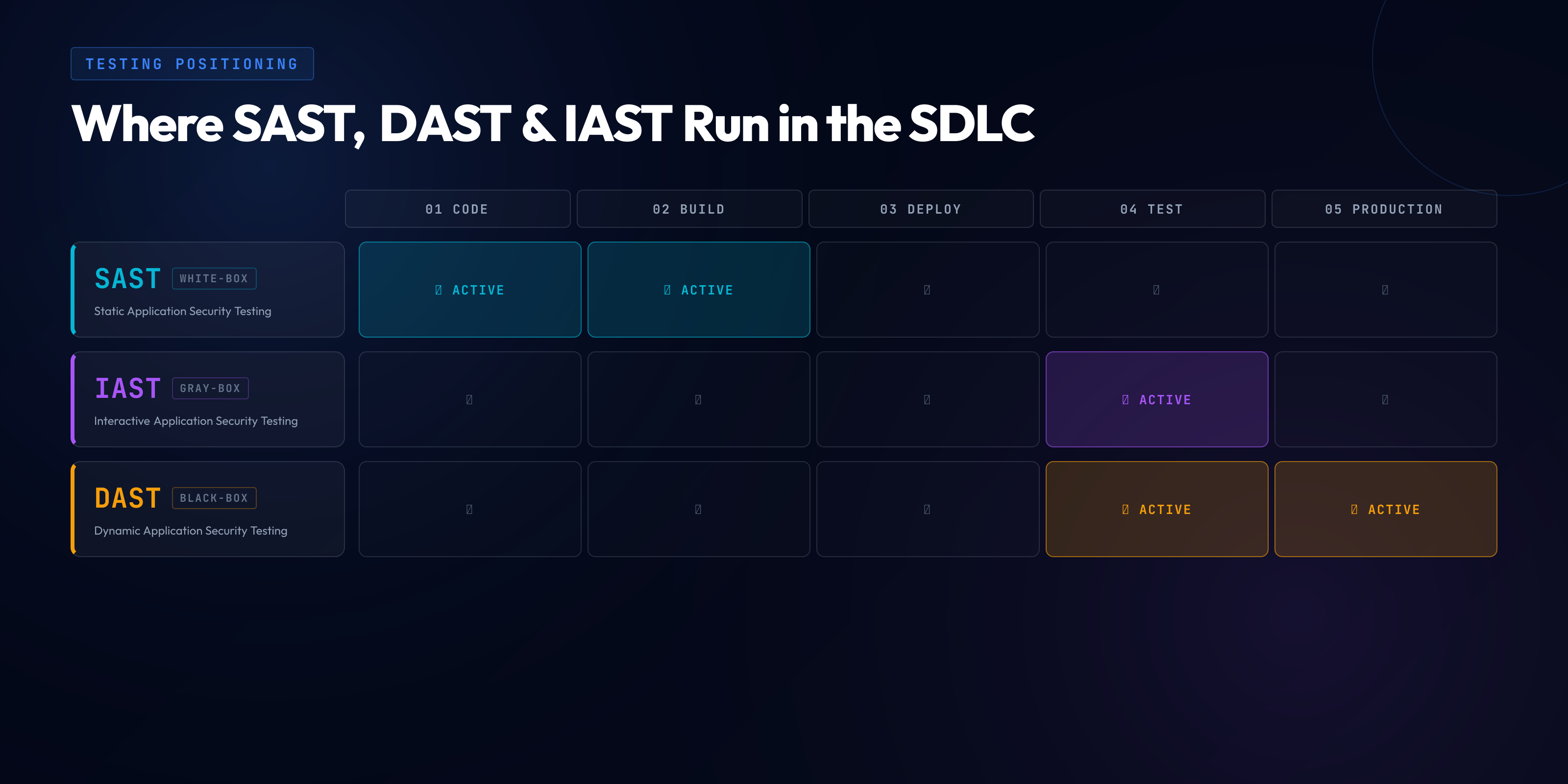
SAST sits primarily in the implementation and verification phases. Its value is highest when the developer is writing code (real-time IDE feedback) and when the change is being reviewed (PR-blocking analysis). It has marginal value in later phases because by the time code reaches staging, the SAST findings have either been fixed or filed as accepted risk.
DAST sits in verification and pre-release. Its value is highest after the application is deployed to a staging environment that closely mirrors production, because that is where runtime configuration issues surface. DAST has limited value in earlier phases because there is no deployed application to scan, and limited value in production because the active scans typically interfere with operations.
IAST sits in verification, alongside the test suite. Its value is bounded by test coverage — a comprehensive test suite makes IAST nearly as valuable as a full DAST scan with the precision of SAST, while a sparse test suite makes IAST a tool that produces a small number of high-confidence findings and an unreliable picture of overall coverage.
The broader arc of the secure SDLC — threat modeling, secure design, secure coding, verification, deployment, monitoring, response — is covered in the Secure SDLC pillar, and one of the points worth restating here is that none of these testing methods replaces threat modeling in design, code review by developers fluent in security, or the use of secure-by-default libraries and frameworks. The methods catch defects; they do not produce architectures that resist defects. Security misconfiguration is the category where DAST shines uniquely and where SAST plus IaC scanning provide the complementary upstream coverage — runtime configuration issues are caught by DAST in staging while misconfigurations introduced through Terraform, Kubernetes manifests, or Helm charts are caught by IaC scanners (Checkov, tfsec, Trivy IaC) before they ever deploy.
For verification programs anchored to a standard, SAST/DAST/IAST findings are the operational evidence for ASVS verification activities. ASVS 5.0 Phase 4 (security testing) consumes the output of all three methods — tagged with the ASVS requirement IDs each finding addresses — and rolls them up into requirement-level pass/fail evidence. The most useful operational pattern is to map each SAST rule, each DAST check, and each IAST agent rule to the ASVS requirement it verifies, then produce a verification report at release time that joins findings against requirements and flags unverified requirements as release blockers. This pattern turns the cost of running three testing methods into compliance evidence that satisfies PCI DSS 6.3, SOC 2 CC7.x, ISO 27001 A.14.2, and EU CRA Annex I as a byproduct rather than as a separate stream.
The point is that SAST, DAST, and IAST are three tools in a much larger toolbox. Any single one is insufficient; even all three combined are insufficient without the design and review disciplines that prevent the worst issues from being introduced in the first place. The methods are complements to those disciplines, not substitutes.
Tools Find Vulnerabilities. Developers Fix Them.
SAST, DAST, and IAST produce findings — sometimes thousands of them — that need developers fluent enough in the underlying vulnerability classes to triage, prioritize, and remediate. A scanner that reports an SQL injection finding is only useful if the developer reading the report knows what parameterized queries look like in their stack and why the safe pattern is safe. SecureCodingHub is how engineering teams build that fluency at the PR level, so the investment in tooling actually translates into fixed code rather than backlogged tickets.
Request a demoChoosing the Right Combination
Most mature application security programs in 2026 run all three methods plus SCA, but the path to that destination matters. Buying every category at once produces shelf-ware in two of them while the team learns to operate the third. The pattern that works in practice is staged.
Stage one: SAST plus SCA. The cheapest combination with the highest baseline coverage. SAST in the IDE and PR pipeline, SCA on every dependency manifest. This combination catches hardcoded secrets, the bulk of injection findings in the changed code, and the entire class of dependency CVEs that account for a substantial fraction of real-world breaches. The deployment cost is low — Semgrep plus Snyk SCA, or Snyk Code plus Snyk Open Source, or GitHub Advanced Security as a single bundled product — and the value is immediate. Most programs should not move to stage two until SAST is producing usable signal at PR time and SCA findings are being fixed within a defined SLO.
Stage two: add DAST on staging. Once the team has an authenticated crawl spec for staging — which often takes weeks to months to develop because it requires understanding the application's authentication, session, and complex flow patterns — DAST adds runtime configuration coverage that SAST cannot reach. The cost is the configuration effort and the staging-environment scan time; the value is catching the OWASP categories (security misconfiguration, missing security headers, server-side issues) that SAST misses entirely. Programs without a staging environment that meaningfully resembles production will struggle to get value from DAST.
Stage three: add IAST when test coverage is mature. IAST is the last of the three to add, not the first, because its value is gated by test coverage. Adding IAST to a codebase with sparse integration tests produces an unreliable picture — the tool reports clean for code paths that were never tested, and the team mistakes silence for safety. Adding IAST to a codebase with mature E2E and integration tests produces high-precision findings on the most exercised flows in the application, which is exactly where IAST's value is highest.
The anti-pattern to avoid is buying an IAST product because the sales conversation is compelling and then discovering that the team's tests do not exercise the sensitive flows the product is supposed to find. The IAST license becomes shelf-ware while the tests remain the actual bottleneck. The same anti-pattern applies in reverse for DAST: buying a DAST product without a usable staging environment produces a tool that scans an application configured differently from production and finds issues that may not exist in production while missing issues that do.
SCA is the unsung pillar. Across the three pillars, SCA — dependency scanning — has the highest find-to-fix ratio of any single method in 2026. Dependency CVEs are the most common entry point in real-world breaches, the findings are precise, and the fix is usually a version bump. A program that runs SCA aggressively and SAST/DAST/IAST mediocrely produces better outcomes than the reverse. SCA is the floor, not the ceiling, but the floor is where most programs should start.
The final and most important point: the tooling stack is only as good as the developers who interpret and remediate its output. A tool that finds a thousand SQL injection candidates is useless if the team does not have the fluency to recognize the safe and unsafe patterns, evaluate exploitability, and apply the architectural fix. The investment in SAST, DAST, IAST, and SCA needs to be paired with a parallel investment in developer training that addresses the specific languages, frameworks, and vulnerability patterns the team's code actually contains. The teams that get the highest return on application security testing investment are the ones that treat tooling and developer education as a single budget line — the tools surface the work, and the trained developers do the work.