Every long-lived repository in your organization has leaked at least one credential. That sentence sounds like rhetorical excess until you point a secret scanning tool at the full git history of any three-year-old codebase. Secret scanning — sometimes called credential detection or credential scanning — is the discipline of finding API keys, passwords, tokens, and private keys in source code, configs, container images, and build logs. This guide covers how leaks actually happen, how detection works, the 2026 tool landscape, why pre-commit hooks alone are not enough, what to do when (not if) you find a leaked credential, and the architectural prevention that keeps the same incident from recurring. The tooling-side companion to this piece is our SCA developer guide; the governance side belongs to DevSecOps.
What Secret Scanning Is and Why Every Repo Has Leaked Credentials
Secret scanning examines source code, configs, container layers, CI logs, and adjacent text corpora to find strings that match the structural patterns of credentials — AWS access keys, GitHub personal access tokens, Stripe secret keys, database connection strings, SSH private keys. The category is conceptually simple. The operational reality is that the first thorough scan of your organization's git history will, almost without exception, produce findings on day one.
The reason is structural, not cultural. Developers commit secrets because dropping a key into a config or hardcoding a connection string is the path of least resistance during local development, and intentions to clean up before pushing fail at some non-zero rate. GitGuardian's State of Secrets Sprawl report counted roughly 23 million distinct secrets detected across public GitHub commits in 2024 alone, a figure that has been roughly doubling every year.
The threat model has two halves. Internally, a leaked credential in a private repo is a privilege-escalation vector for anyone with read access — and read access expands through team changes, contractors, and acquisitions. Externally, a credential in a public repo is harvested by automated scanners within seconds. On public GitHub, median time from commit to first attacker access of a leaked AWS access key is 30-60 seconds, faster than your CI pipeline runs.
Recent incidents make the threat concrete. The Uber 2022 breach traced in part to a HashiCorp Vault privileged access token embedded in a PowerShell script committed to an internal repo — the attacker who phished an Uber contractor used that leaked token to escalate into Uber's secret-management infrastructure. The Toyota 2023 GitHub leak exposed data on roughly 260,000 customers because an API key had sat in a public repository for five years before discovery. The Mercedes-Benz 2024 incident saw a GitHub Actions token with broad write permissions leaked through a misconfigured public repository, giving the researcher access to internal source and blueprints. None required novel attacker capability — each was the predictable consequence of a credential sitting in the wrong place long enough.
The same "wrong place long enough" failure mode generalises beyond credentials, and modern secret-scanning programs increasingly extend their scan surface to published build artifacts for exactly this reason. The Anthropic Claude Code source map exposure in March 2026 is the canonical example: a 59.8MB source map shipped inside the public npm package re-exposed roughly 512,000 lines of proprietary TypeScript — including internal agent logic and anti-distillation mechanisms — because a single build-config switch left .map files in a production artifact. Source maps are an underappreciated leak surface twice over: they re-publish full source through a channel most repo-side scanners do not watch, and they routinely retain string constants — config values, internal URLs, embedded API endpoints, and occasionally hardcoded tokens — that minification removed from the executable bundle. Any serious 2026 scanning program treats published npm tarballs, Docker images, and front-end build outputs as in-scope alongside the repo itself.
The Anatomy of a Leaked Secret
A leaked credential follows a predictable lifecycle: commit, push, exposure, harvest. Each stage offers different defensive opportunities with different cost and different effectiveness.
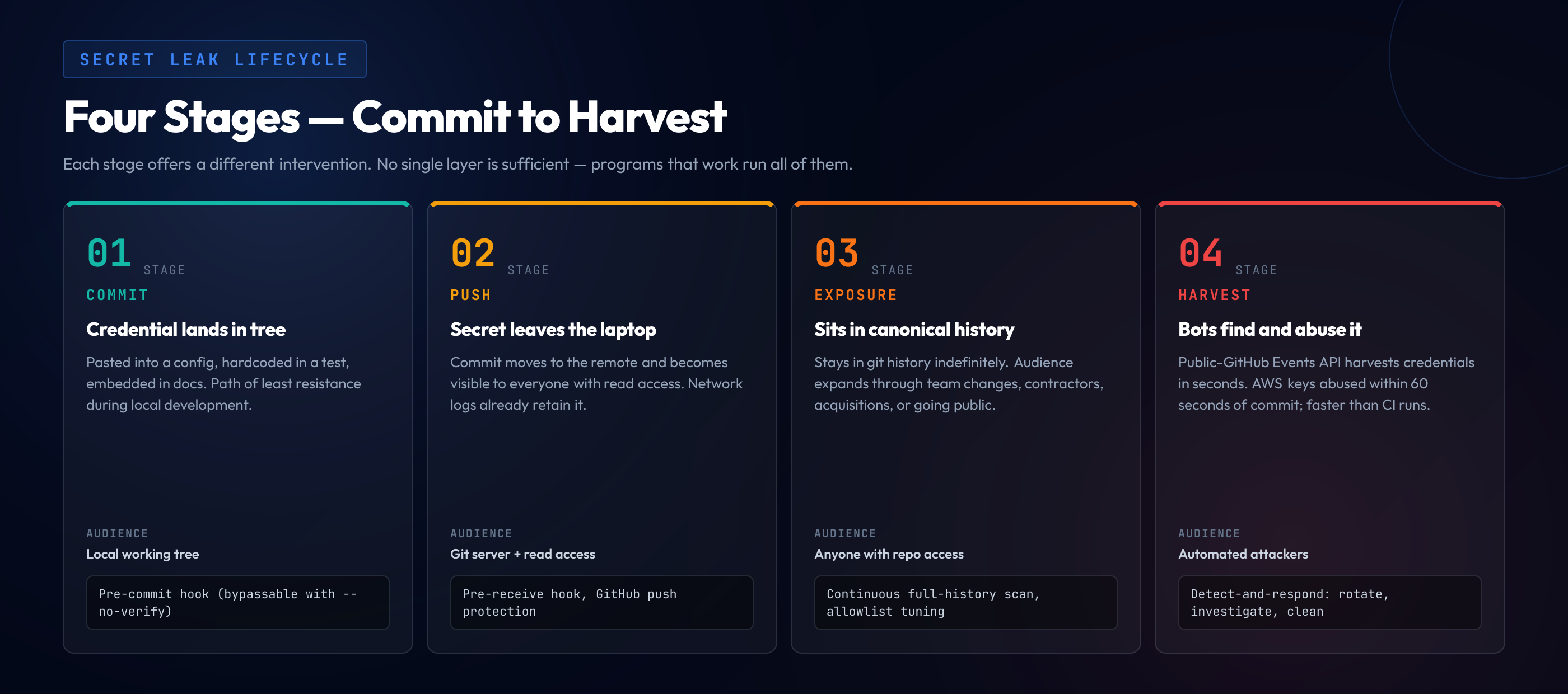
Stage one: commit. The credential lands in the working tree — pasted into a config, hardcoded in a test, embedded in documentation. Only one intervention applies: a pre-commit hook that examines the staged diff and refuses the commit on detection. Pre-commit is the cheapest intervention computationally and the most fragile by enforcement — a local hook can be bypassed with --no-verify, disabled, or never installed on a new machine.
Stage two: push. The credential moves to the remote and becomes visible to everyone with read access. The intervention is server-side: a pre-receive hook or platform service like GitHub Secret Scanning that rejects or alerts on incoming pushes. Server-side closes the bypass gap of pre-commit, but the secret has already left the developer's machine by the time the push is rejected.
Stage three: exposure. The credential is in the canonical history. Audience is whoever has read access — private repos expand and contract with team changes and acquisitions; public repos are the whole internet. Exposure is the longest stage in time because secrets in git history rarely get removed.
Stage four: harvest. An automated scanner finds and extracts the credential. On public GitHub, harvest is essentially instantaneous because bots subscribe to the Events API specifically to find credentials. Truffle Security has documented AWS keys being abused within 60 seconds of commit. The only intervention left is detection-and-response: monitor for unusual API usage, rotate on suspicion, and have an incident-response playbook ready for the day a leak turns into a billing alert.
The lifecycle's core insight is that no single layer is sufficient. Pre-commit misses what it misses; server-side is too late for some classes; continuous catches the rest but cannot prevent the initial exposure. Programs that work run all three layers on top of architectural changes that reduce how often credentials reach source-code form in the first place.
Detection Strategies
The technical core of any scanner is the detection engine — the algorithm that decides whether a string is a credential. The problem is harder than it sounds because credentials do not all look the same, distinctive ones are vastly outnumbered by random-looking non-credentials, and the cost of false positives is high enough to produce alert fatigue within days. Modern scanners combine four strategies.
Regex and pattern matching. A library of expressions derived from documented formats — AWS access keys begin with AKIA or ASIA plus 16 uppercase alphanumerics; GitHub PATs begin with ghp_ plus 36 alphanumerics; Stripe live keys begin with sk_live_. Fast, deterministic, high confidence on distinctive patterns. Weakness: coverage. Regex catches only credentials whose format is publicly documented and distinctive enough, which excludes the long tail of internal tokens and generic 32-character hex strings.
Entropy-based detection. Credentials by design carry enough randomness to resist guessing; source code is low-entropy. An entropy detector flags strings above a Shannon-entropy threshold (typically 4.0-4.5 bits per character for base64 or hex). Universal technique for credentials with no documented format. False-positive profile is the issue: hash digests, build artifact IDs, UUIDs in test fixtures, and minified JS all trip the threshold.
ML classifiers. Models trained on labeled credential and non-credential examples, incorporating context — surrounding code, variable name, file path — that pure regex and entropy ignore. x9k2mP8nQ4rT is suspicious in const apiKey = "x9k2mP8nQ4rT" and not in a comment. Harder to audit and need ongoing training. GitGuardian, GitHub Secret Scanning, and commercial TruffleHog use ML augmentation; most open-source tools do not.
Partial-match heuristics. Combine surrounding signals — variable names like SECRET, TOKEN, PASSWORD, API_KEY near high-entropy strings; placeholder values like changeme or your-key-here — into findings. Catch what other techniques miss and produce more false positives in exchange.
No single technique covers the space. Mature scanners combine all four. Well-tuned false-positive rates sit at 5-20% on typical codebases, and false-negative rates against a developer actively trying to evade detection are high enough that scanning alone is never the complete answer.
The Tool Landscape
The 2026 market has stratified into open-source CLIs, platform-integrated services, and commercial enterprise tools. The choice of tool matters less than the choice to run multiple in combination at the right pipeline stages.
Gitleaks. The dominant open-source scanner. Go, single binary, TOML config, suited to both pre-commit and CI. Strengths: speed and simplicity. Weaknesses: mostly regex with limited entropy, no ML, higher false-positive rate than commercial tools. Right starting point for most teams.
TruffleHog. Go scanner with open-source and commercial tiers. Distinguishing feature: verification — TruffleHog calls the issuing service's API to confirm the credential is valid before reporting. Verified findings collapse false-positives to near zero. Tradeoff: external API calls are slow, rate-limited, or unwanted in air-gapped environments.
GitHub Secret Scanning. Free on public repos; paid on private repos via GitHub Advanced Security. Platform integration is the strongest argument — partners (AWS, Stripe, ~200 others) receive automatic notification on detection and can revoke before the leak window closes. Limitation: only catches partner-registered formats.
GitGuardian. The commercial leader. Combines regex, entropy, and ML; broad credential coverage; the most comprehensive incident-response workflow in the category. The State of Secrets Sprawl numbers come from their data. Enterprise-tier pricing; defensible default with budget.
AWS Macie. Scans S3 for sensitive data including credentials, PII, and regulated classes. Useful for the lateral concern — credentials in backups, log archives, or customer exports uploaded to S3. Complement to code-focused tools, not replacement.
detect-secrets. Yelp's open-source scanner with a baseline workflow — generate a baseline on first run, ignore findings already there, surface only new findings. Practical for rolling out scanning on mature codebases without spending weeks triaging historical findings first.
Talisman. Thoughtworks' pre-commit-focused open-source tool, built specifically for the git-hook case. Less actively maintained than Gitleaks; reasonable for teams wanting a dedicated pre-commit scanner.
ggshield. GitGuardian's open-source CLI, backed by their detection engine, integrated into pre-commit, pre-push, and CI. Right choice when already on GitGuardian.
Honest summary: start with Gitleaks or TruffleHog at pre-commit and CI, enable GitHub Secret Scanning at the platform layer if you are on GitHub, and consider GitGuardian when open-source false-positive rates become a real operational cost. Layered combination is the architecture.
Pre-commit vs Server-side vs Continuous Scanning
The integration decision — where in the pipeline the scanner runs — separates programs that catch leaks from programs that produce dashboards. Mature programs run three layers.
Pre-commit scanning. Runs locally on the developer's machine, examining the staged diff and refusing the commit on detection. Strength: prevents the leak entirely. Weaknesses: enforcement (local hooks are bypassable with --no-verify, can be disabled, may not be installed on a new machine) and coverage (the GitHub web UI, some Codespaces configurations, and automated CI commits bypass the hook).
A pre-commit-framework hook running Gitleaks:
# .pre-commit-config.yaml
repos:
  - repo: https://github.com/gitleaks/gitleaks
    rev: v8.18.4
    hooks:
      - id: gitleaks
        name: Detect hardcoded secrets
        entry: gitleaks protect --staged --verbose --redact
        language: golang
        pass_filenames: false
A minimal .gitleaks.toml with an allowlist for known false positives:
# .gitleaks.toml
title = "Project Gitleaks Config"

[extend]
useDefault = true

[allowlist]
description = "Known false positives and test fixtures"
paths = [
  '''(?i)test/fixtures/.*\.json''',
  '''(?i)docs/examples/.*\.md''',
]
regexes = [
  # AWS docs example key, not real
  '''AKIAIOSFODNN7EXAMPLE''',
  # Stripe test-mode keys are not sensitive
  '''sk_test_[0-9a-zA-Z]{24,}''',
]

[[rules]]
id = "internal-api-token"
description = "Internal service API token"
regex = '''(?i)internal[_-]?token['"\s:=]+['"]?([A-Za-z0-9_\-]{32,})'''
tags = ["internal", "high"]
Server-side scanning. Runs on the git server (or a CI step on push) and examines incoming pushes. Closes the bypass gap of pre-commit. Tradeoff: rejection happens after the commit left the developer's machine, so the credential exists in network logs even if the push is refused. Alerting is more reliable than relying on local hooks.
A GitHub Actions workflow running TruffleHog on PRs, blocking merges on verified findings:
name: Secret Scan
on:
  pull_request:
    branches: [main, develop]
  push:
    branches: [main]

jobs:
  trufflehog:
    runs-on: ubuntu-latest
    steps:
      - uses: actions/checkout@v4
        with:
          fetch-depth: 0

      - name: Run TruffleHog
        uses: trufflesecurity/trufflehog@main
        with:
          path: ./
          base: ${{ github.event.repository.default_branch }}
          head: HEAD
          extra_args: --only-verified --fail
Continuous scanning. Runs full-history scans on a schedule or in response to events (repo made public, contributor access change). Catches credentials committed before the scanner was deployed, during hook-disabled windows, or in repos that joined through acquisition or migration.
The performance tradeoff is concrete: pre-commit must complete in seconds (longer latency produces hook-disabling), server-side has tens of seconds to a minute, and continuous can run for hours overnight. A single-tool answer at all three layers usually compromises something.
The Public-Repo Exposure Reality
GitGuardian's State of Secrets Sprawl 2024 reported approximately 23 million distinct secrets detected in public GitHub commits during 2024 alone — roughly 10% growth over 2023 and 4x growth over 2020. Growth is happening in absolute terms despite tooling improving substantially in the same window, which means developers are committing credentials faster than prevention tools catch them.
The exposure window between commit and harvest is the metric that matters most. Truffle Security's research and similar vendor work converges on a sub-minute median time-to-first-attacker-access for AWS keys on public GitHub. The mechanism is not subtle: GitHub publishes a real-time event stream of public activity through its Events API, and harvesting bots subscribe to that stream specifically to find credentials. A credential committed at 3:14:00 has, on average, been pulled and tested for validity by 3:14:30. If the credential authorizes anything attackers can monetize — compute (mining), data (resale), further access (lateral movement) — it gets used within the next minute. If not, it is cataloged for later.
The implication for incident response is direct: by the time a developer notices they pushed a credential, the credential is already compromised. The window is shorter than the human cognitive loop. Rotation is first in the playbook not because it is sufficient but because it is the only action that takes effect in a useful timeframe — rotate first, investigate second, clean history last; reversing any stage produces a worse outcome.
The private-repo reality is slower but no less serious. A credential in a private repo is exposed to whoever has read access, which expands and contracts over years through team changes, contractors, and acquisitions. The Toyota incident was exactly this pattern — a credential in a repository that was, at various times, public and private, with the exposure window spanning the public periods.
Cleaning Up After a Leak
The day will come when your scanner finds a credential in production, or worse, when a cloud-provider billing alert or researcher email tells you a leaked credential has been exploited. The remediation has three steps in a specific order; getting the order wrong is a self-inflicted second incident.
Step one: rotate. Generate a new credential, deploy it to every service that needs it, and revoke the old one. Rotation must happen before any history-rewriting because rewriting does not invalidate credentials that have already been exposed — if the credential ever reached the remote, assume compromised. "Force push and forget" — treating history rewriting as the remediation — is malpractice. The credential is rotated by being replaced, not by being absent from current history.
Step two: investigate. Pull audit logs from the service the credential authenticates to, look for usage that doesn't match expected activity, identify the compromise window, and document the impact. Investigation feeds breach-disclosure, retrospectives, and compliance reporting. It should also identify how the credential leaked — which developer, which scanner missed it, which workflow allowed it — so the gap can be closed architecturally.
Step three: clean history. Only after rotation and investigation is history-rewriting appropriate, and even then the value is debatable. git filter-repo (the modern replacement for git filter-branch) requires force-pushing the rewritten history, invalidating every local clone, breaking open PRs, and leaving original commits accessible through cached references — GitHub retains pushed commits for a period after they're unreachable, and external mirrors may persist indefinitely. History rewriting reduces but does not eliminate exposure. Many mature teams skip it entirely.
Narrow cases where rewriting is genuinely valuable: the credential cannot be rotated (a third-party service that issues only one key per account), the leaked content is non-credential sensitive data (PII, IP-sensitive source, internal documentation), or regulatory requirements mandate removal.
The reciprocal concerns to credential leaks belong to cryptographic key management on the technical side and to software and data integrity failures on the supply-chain side — a leaked CI token is exactly the kind of foothold A08 describes attackers using to pivot into supply-chain compromise.
False-Positive Discipline
The single largest predictor of whether a program succeeds or fails is the false-positive rate the team tolerates. A scanner producing 200 findings per PR is ignored within two weeks; a scanner producing three findings of which one is real gets acted on. False-positive discipline is the operational core, more important than the choice of scanner.
The mechanism is the allowlist — known-non-secret strings, paths, or patterns the scanner ignores. Allowlists differ from ignore patterns in scope: allowlists cover specific known cases (a documented example AWS key, a Stripe test-mode key); ignore patterns cover categories (anything in test/fixtures/). The allowlist must be code-reviewed alongside the scanner config, with each entry commented for why it exists. Quarterly review prevents the allowlist from accumulating entries that mask real findings.
The false-positive rate budget is the policy decision that anchors the program. A 5% target spends modest triage effort and misses few real findings; 1% spends more and misses none; 20%+ burns alert credibility within months. The right budget depends on triage capacity, leak severity, and finding volume.
Alert fatigue is the failure mode that kills programs. Humans presented with mostly-false alerts learn to dismiss alerts before reading, and the rare true alert dies in the noise. Once the team has trained itself to ignore the channel, no amount of "this one is real" recovers the trust. Tuning the false-positive rate matters more than expanding coverage — a scanner producing 50 findings of which 5 are real is operationally worse than one producing 10 findings of which 5 are real.
The entropy-tuning tradeoff is the concrete instance: entropy thresholds directly control the false-positive rate. Lower the threshold and you catch more credentials and more noise; raise it and you miss credentials with lower-than-typical randomness. The right setting is whatever produces a tolerable false-positive rate while catching the credential types the threat model cares about — find it by scanning a sample at multiple thresholds and picking the knee on the precision-recall curve.
Architectural Prevention
Detection catches credentials already written to source. Prevention — patterns that keep credentials out of source entirely — is the layer that produces asymptotic reduction in leak rate. Teams with the lowest incident rates are the ones whose architecture makes committing a secret structurally difficult.
Secret managers. A centralized service that stores, issues, audits, and rotates credentials. The 2026 options: HashiCorp Vault, AWS Secrets Manager and Parameter Store, Google Cloud Secret Manager, Azure Key Vault, Doppler, and 1Password Secrets Automation. Common property: application code retrieves credentials at runtime rather than reading from config, so nothing ever commits.
Environment injection. Credentials are injected into the process environment at start time rather than read from disk. Injection happens through the orchestration layer — Kubernetes Secrets, ECS task definitions, GitHub Actions secrets, GitLab CI variables — and the app reads from process.env.
Never-touch-disk patterns. The discipline of never letting credentials persist to disk in plaintext. .env files, despite their universal habit, are exactly the wrong pattern at scale — they create plaintext credentials at well-known paths and are the file pattern most likely to be accidentally committed (the .gitignore entry that should exclude them is the entry developers most often forget). Mature teams treat .env as a code-smell to migrate, not a baseline practice.
Short-lived credentials and OIDC federation. The most architecturally significant change of the last five years: the shift from long-lived credentials (AWS access keys good for years) to short-lived credentials issued through OIDC federation (tokens good for an hour, scoped to a specific role and workload). GitHub Actions, GitLab CI, CircleCI, and most modern CI platforms support OIDC against AWS, GCP, and Azure, eliminating long-lived cloud access keys from CI entirely.
AWS OIDC federation in GitHub Actions, replacing a long-lived access key with a short-lived assume-role token:
name: Deploy
on:
  push:
    branches: [main]

permissions:
  id-token: write
  contents: read

jobs:
  deploy:
    runs-on: ubuntu-latest
    steps:
      - uses: actions/checkout@v4

      - name: Configure AWS credentials via OIDC
        uses: aws-actions/configure-aws-credentials@v4
        with:
          role-to-assume: arn:aws:iam::123456789012:role/github-actions-deploy
          role-session-name: github-actions-${{ github.run_id }}
          aws-region: us-east-1
          # No access key, no secret key — OIDC handles auth

      - name: Deploy
        run: ./deploy.sh
A HashiCorp Vault dynamic database credential pattern — Vault generates a per-request database user with a short TTL and revokes it on expiry:
import hvac, psycopg2, os

client = hvac.Client(url='https://vault.internal:8200')
client.auth.approle.login(
    role_id=os.environ['VAULT_ROLE_ID'],
    secret_id=os.environ['VAULT_SECRET_ID'],
)

# Vault generates a fresh PostgreSQL user with e.g. 1h TTL,
# auto-revokes when the lease expires.
creds = client.secrets.database.generate_credentials(name='app-readonly')

conn = psycopg2.connect(
    host='db.internal',
    user=creds['data']['username'],
    password=creds['data']['password'],
    dbname='app',
)
# No long-lived credential ever exists in code, config, or env.
A team that has adopted secret managers, environment injection, never-touch-disk practices, and short-lived credentials has structurally limited what can be leaked. A leaked OIDC token is good for an hour; a leaked Vault credential expires with the lease. The blast radius of any single leak is small enough to recover through routine rotation rather than crisis response.
The Mitigation Playbook
A mature program is not a tool deployment; it is a sequence of organizational changes. The playbook below is what successful teams converge on, in roughly the order the changes are most effective.
Org-wide pre-commit baseline. Roll out a pre-commit hook as part of the standard developer-environment setup, installed via the repo's bootstrap script and configured in .pre-commit-config.yaml. The point is not to make it unbypassable; it is to make pre-commit the path of least resistance. Catches the majority of inadvertent commits.
Server-side block on push. Configure the git server to refuse or alert on pushes with detected secrets. On GitHub: Secret Scanning with push protection (paid on Advanced Security). On GitLab: Secret Detection in Auto DevOps. On self-hosted forges: pre-receive hooks running Gitleaks or TruffleHog.
Continuous scan of historical commits. Recurring full-history scan of every repo — weekly for most teams, daily for higher-risk environments. Catches credentials committed before the scanners were deployed.
Secret rotation playbook. Document rotation steps for every credential type — AWS IAM keys, internal service tokens, TLS certificates. Specify who is responsible, what services need updating, what downtime, and what confirms success. A team figuring out secret rotation during an active incident has lost time it cannot afford.
Secret-manager adoption rollout. Migrate every long-lived credential from source-or-config storage to a secret manager on a deliberate timeline with executive sponsorship. The migration is unglamorous and produces no immediate visible benefit, which is why it perpetually slips.
Training. Training that works in 2026 is not a quarterly slideshow; it is hands-on practice — reviewing a PR that introduces a hardcoded credential, rotating a credential under simulated incident pressure, migrating a service from .env to a secret manager.
If your team is rolling out secret-scanning enablement and looking for hands-on training that goes beyond the slideshow — drilling developers on real leaked-credential scenarios, real rotation procedures, and real architectural patterns — our platform's developer-training labs walk through the full incident-response lifecycle. The skill we build is the judgment to recognize a leaked credential before it lands, to respond without making the situation worse, and to drive the architectural changes that prevent recurrence.
Secret Scanners Find Leaked Credentials. Developers Decide What to Do About Them.
A scanner that flags 50 secrets in CI is the start of the work, not the end. The hard part is the operational follow-through — distinguishing real findings from noise, rotating in the right order, refusing to "force push and forget," and making the architectural changes that prevent the same leak class from recurring. SecureCodingHub's platform builds the secret-aware judgment that turns scanner output into operational signal: developers who recognize hardcoded credentials in code review, know the three-step incident-response order, and can advocate for short-lived credentials and OIDC federation when they see long-lived keys in CI configs.
See the PlatformClosing: Secret Scanning as Continuous Practice
The mistake most programs make is treating the discipline as a tool deployment: install Gitleaks, enable GitHub Secret Scanning, call it done. Every analysis above — the four-stage lifecycle, the false-positive crisis, the layered-defense argument, the architectural-prevention shift — points the other direction. Secret scanning is a continuous practice that runs alongside development, integrates into all three layers, produces ongoing findings that need ongoing triage. The Uber, Toyota, and Mercedes-Benz incidents were each preventable through the practices above; they happened because at some point the practices were not followed consistently.
Mature programs share a small set of habits. Pre-commit, server-side, and continuous scanning together. False-positive rate tuned to what the team can actually attend to. An incident-response playbook that starts with rotation and never suggests "force push and forget." Long-lived credentials migrated to secret managers; cloud access keys replaced with OIDC federation; .env files treated as a code-smell. Developer training as a primary investment.
None of this is exotic. The institutional commitment to apply it consistently is what separates programs that produce signal from programs that produce dashboards. The companion practices — application-security testing for the code itself, SCA for the dependency tree, secret scanning for the credentials that tie them together — are increasingly inseparable, and the program that runs one without the others has the gaps the next incident finds.