A cybersecurity risk assessment is one of those phrases that gets read very differently depending on who is reading it. To a GRC analyst, it is a structured workflow that produces a register, a heatmap, and a treatment plan. To an engineering leader, it is the upstream artifact that should — but rarely does — explain why the next two sprints contain three security stories instead of two new features. This guide is written for the second reader. The frameworks (NIST SP 800-30, ISO 27005, OCTAVE, FAIR) are covered, the qualitative-vs-quantitative debate is resolved with engineering examples, and the part of the cyber security risk assessment process that actually touches the team shipping the code is treated as the primary concern rather than a footnote. If you have ever inherited a risk register and wondered how it was supposed to drive your backlog, this is the walkthrough.
What Is a Cybersecurity Risk Assessment?
A cybersecurity risk assessment is a structured analysis that identifies what an organization's information assets are, what threats and vulnerabilities they face, what the likelihood and impact of compromise would be, and what should be done about each identified risk. The output is a risk register: a list of risks with attributes (asset, threat, vulnerability, likelihood, impact, score, treatment, owner) that becomes both a planning artifact for security investment and a record artifact for compliance.
The standard process — drawn from NIST SP 800-30 Rev.1 and broadly equivalent in ISO 27005 and the other major frameworks — runs through four logical stages: identify the risks, analyze their probable likelihood and impact, evaluate them against the organization's tolerance, and treat them through one of four responses (accept, mitigate, transfer, avoid). Around that core sits a fifth activity that distinguishes a serious program from a paper one: monitor the risks continuously as the system, the threat landscape, and the organization's controls evolve.
The framing that matters for an engineering audience is the difference between a risk assessment as an audit artifact and a risk assessment as an operational tool. The first sits in a SharePoint folder, gets dusted off for the annual SOC 2 review, and has roughly zero contact with the team writing the code. The second feeds into architecture review meetings, surfaces in the next sprint's backlog as concrete tickets, and gets updated when the SCA tool flags a new high-severity CVE in a transitive dependency. The vocabulary used to express each finding in that register — the CWE IDs attached by scanners, in CVE feeds, and on bug-bounty platforms — is itself worth understanding before reading further; our what is a CWE guide covers it. Most organizations have the first kind. The organizations whose risk-driven decisions actually correspond to where the actual risk lives have the second kind.
Why Developers Should Care About Risk Assessment
The standard answer to "why should developers care about risk assessment" is some variation of "because security is everyone's responsibility," which is the kind of sentence that appears in compliance training and produces no behavior change. The honest answer is more specific: a working it security risk assessment becomes the engineering team's prioritization input. The risks identified in the register are, with a delay of about one sprint, the tickets that show up in your queue. If the register is wrong — over-weighting risks that do not match the actual attack surface, under-weighting risks that do — the team's effort flows toward the wrong fixes.
Concretely, the risk assessment shapes engineering work in five places. First, the design phase: when a new service or feature crosses a trust boundary, the risks identified in the assessment determine which threats the design has to defend against. Second, the technology selection: a risk register flagging supply-chain compromise as a top concern changes the calculus on which dependencies are acceptable. Third, the test plan: the residual risks identified by the assessment dictate which abuse cases the QA and security testing have to cover. Fourth, the runtime configuration: risk-driven decisions about logging verbosity, rate limits, and feature flags trace directly to the impact estimates in the register. Fifth, the on-call posture: the risks rated as high-likelihood, high-impact are the ones whose detection rules need to fire reliably and whose runbooks need to exist.
The connection back to the lifecycle work is direct. The risk assessment is the input that should arrive in Phase 1 of a secure software development lifecycle, where it becomes part of the security requirements set for every feature in scope. Teams that skip the upstream risk assessment end up with security requirements that read like generic best-practice lists, which produce code that is generically secure but specifically miscalibrated to the threats the system actually faces.
The Five Steps of a Cybersecurity Risk Assessment Process
Different frameworks count steps differently — NIST has nine sub-tasks, ISO 27005 has six clauses — but the substance condenses to five. The names matter less than ensuring each set of activities actually happens, with artifacts the engineering team can read.
| Step | Core activity | Engineering artifact |
|---|---|---|
| 1. Asset inventory | Identify and classify what you are protecting | Service catalog with data classifications |
| 2. Threat identification | Enumerate adversaries and their plausible actions | Threat catalog, MITRE ATT&CK mapping |
| 3. Vulnerability identification | Find weaknesses each threat could exploit | SAST/DAST/SCA findings, pentest reports |
| 4. Impact and likelihood analysis | Estimate consequences and probability | Scored risk register entries |
| 5. Risk evaluation and treatment | Decide accept / mitigate / transfer / avoid | Backlog tickets, accepted-risk records |
Step 1: Asset inventory. The list of things the organization owns that have value and could be compromised — services, data stores, credentials, key material, build infrastructure, the developer laptops with source code on them. The classification per asset is what drives everything downstream: a database holding restricted data has a much higher impact ceiling than a marketing static site, and the risk assessment that treats them equivalently is structurally broken. In 2026, the asset inventory is increasingly built from runtime sources — service meshes, cloud asset graphs, SBOMs — rather than maintained as a manual spreadsheet, because the manual version is always stale.
Step 2: Threat identification. For each asset (or asset class), what adversaries plausibly target it and what actions would they take? The MITRE ATT&CK framework is the dominant reference for the adversary-behavior catalog; threat intelligence feeds, sector-specific ISACs, and the organization's own incident history fill in the specific threats. The output is not a generic list of "threats" — it is a catalog tied to the assets, where each threat is a concrete attacker action like "exfiltrate customer PII via SQL injection on the public web tier" or "compromise the build pipeline via a malicious dependency".
Step 3: Vulnerability identification. For each threat, what specific weaknesses make the threat realizable? This is where the engineering tooling output becomes a primary input: SAST findings, DAST findings, SCA findings, container image scan results, IaC scan results, pentest reports, bug bounty reports. A vulnerability without a corresponding threat is noise; a threat without a corresponding vulnerability is either a future risk worth designing for, or a control gap worth closing. The mapping is what produces actionable risk entries rather than the two parallel lists most organizations end up with.
Step 4: Impact and likelihood analysis. Each (asset × threat × vulnerability) tuple gets scored. Impact is the consequence if the risk is realized — financial, regulatory, reputational, operational. Likelihood is the probability of realization in the assessment window, conditioned on the existing controls. The scoring methodology (qualitative or quantitative) is covered in its own section below; what matters here is that the score has to be defensible. A risk rated "high" because somebody felt strongly about it does not survive the next leadership change.
Step 5: Risk evaluation and treatment. The risks are ranked, compared against the organization's risk appetite, and a treatment is selected for each. The four canonical responses — accept, mitigate, transfer, avoid — are covered in detail later. The output of this step is a treatment plan that translates into either backlog work (mitigations), insurance contracts (transfers), accepted-risk records signed by an authorized executive (acceptances), or architectural decisions to remove the risky capability altogether (avoidances).
Frameworks Compared: NIST RMF, ISO 27005, OCTAVE, FAIR
The framework chosen as a primary reference shapes how the risk assessment looks more than any other single decision. Four frameworks dominate the conversation in 2026, and the choice is rarely purely technical — it is also a choice about what language to speak with auditors, board members, and peer organizations.
NIST Risk Management Framework (SP 800-30, 800-37, 800-39). The nist risk assessment reference is SP 800-30 Rev.1, which prescribes the conduct of risk assessments at the information-system level. SP 800-37 Rev.2 is the broader RMF — the seven steps from preparation through authorization and continuous monitoring — and SP 800-39 is the enterprise-tier risk management view. Together they form the most prescriptive public risk management framework. NIST is the de facto standard for U.S. federal contracting, is increasingly cited in private-sector procurement, and is the framework most likely to be specifically named in compliance language. Its weakness is that the prescriptiveness reflects federal-agency context and does not always translate cleanly to a fast-moving SaaS engineering organization.
ISO/IEC 27005:2022. The international standard for information security risk management, designed to support ISO 27001's information security management system. ISO 27005 is less prescriptive than NIST — it specifies the process and required outputs without specifying the specific methods to produce them — which makes it more flexible across organizational contexts. For organizations that already operate under an ISO 27001 ISMS, 27005 is the natural risk methodology because it is designed to plug in. The 2022 revision aligns more closely with ISO 31000 (the general enterprise risk standard) and makes the integration with broader enterprise risk easier.
OCTAVE Allegro. The Carnegie Mellon SEI methodology, focused on operational risk to information assets. OCTAVE Allegro is the streamlined variant of the original OCTAVE framework, produced specifically because the full OCTAVE was too heavy for most organizations. Its distinguishing property is the asset-centric framing — every risk is tied back to a specific information asset and its containers — which produces a register that is unusually legible to business stakeholders. OCTAVE has fallen behind NIST and ISO in adoption since the mid-2010s but remains a strong choice for organizations that find the major frameworks too process-heavy.
FAIR (Factor Analysis of Information Risk). A quantitative framework that decomposes risk into measurable factors — threat event frequency, vulnerability, primary loss magnitude, secondary loss magnitude — and produces probabilistic loss distributions rather than ordinal risk ratings. FAIR is not really an alternative to NIST or ISO at the process level; it is an alternative to the qualitative scoring methodology those frameworks default to. Organizations that need to justify security investment in dollar terms (board reporting, cyber insurance, risk transfer decisions) increasingly use FAIR for the highest-impact risks even if their overall program is NIST or ISO based.
The practical pattern in 2026 is to pick NIST or ISO as the primary process frame (NIST if federal-aligned or U.S.-centric, ISO if international or already running an ISMS), use FAIR for quantitative scoring on the handful of risks where dollar-denominated estimates are needed, and reference OCTAVE Allegro for asset-centric framing where it improves stakeholder legibility. Picking one framework in isolation tends to produce gaps; referencing several tends to produce a program that fits the organization's reality.
Qualitative vs Quantitative Risk Scoring
The qualitative vs quantitative risk debate is one of the longest-running in the security profession, and the resolution is less interesting than the people most invested in either side make it. Both approaches have legitimate uses; the question is which one applies to which risk.
Qualitative scoring. Risks are rated on ordinal scales — typically 1-5 for likelihood and 1-5 for impact, multiplied or matrixed into an overall score. The output is a heat map: green / yellow / orange / red regions on a 5×5 grid, with risks placed by their (likelihood, impact) coordinates. The advantages are speed and accessibility — a team can produce a usable qualitative assessment in a few days, and the output is legible to non-specialist stakeholders. The disadvantages are well-documented: ordinal scales do not support arithmetic (a "4" is not twice a "2"), the assignments are subject to consistent biases (recent incidents inflate likelihood, low-frequency-high-impact risks get under-weighted), and aggregating qualitative scores across many risks produces numbers that look quantitative but are not.
Quantitative scoring. Risks are expressed as probability distributions over loss magnitude. FAIR's annualized loss expectancy (ALE) is the canonical example: a risk has a probability distribution over how many times per year the loss event occurs, multiplied by a probability distribution over the dollar magnitude of each occurrence, sampled via Monte Carlo to produce a loss distribution with confidence intervals. The advantages are arithmetic legitimacy (you can sum, compare, optimize), defensibility (the inputs and method are explicit), and direct comparability with other financial decisions. The disadvantages are cost (a quantitative analysis on a single risk is often a multi-day exercise) and the danger of false precision (a beautifully calculated $1.2M ALE based on guessed inputs is not better than a "high" rating).
The right answer for most engineering organizations is a tiered approach. Qualitative scoring on every risk in the register produces a triage layer fast enough to keep up with shipping. Quantitative scoring on the top 10-20 risks — the ones likely to drive material investment decisions — produces the analytical depth those decisions deserve. Trying to apply quantitative methods uniformly drowns the program in analysis cost; trying to drive board-level capital decisions purely from a heat map undersells the rigor those decisions need.
A simple 5×5 likelihood-by-impact matrix, used as the default qualitative tool, looks like this:
| Likelihood ↓ / Impact → | 1 Negligible | 2 Minor | 3 Moderate | 4 Major | 5 Severe |
|---|---|---|---|---|---|
| 5 Almost certain | Medium | High | High | Critical | Critical |
| 4 Likely | Medium | Medium | High | High | Critical |
| 3 Possible | Low | Medium | Medium | High | High |
| 2 Unlikely | Low | Low | Medium | Medium | High |
| 1 Rare | Low | Low | Low | Medium | Medium |
The matrix is a tool, not an answer. The mistake that turns it into theater is treating the cell color as a decision rather than a triage signal. "Critical" risks get further analysis (often quantitative); "Low" risks get accepted or batched. The matrix is the index, not the conclusion.
Risk Assessment vs Threat Modeling
Risk assessment and threat modeling overlap enough to be conflated and differ enough that the conflation produces real problems. The two activities are complementary; neither substitutes for the other. The distinction worth carrying around is directional. A cybersecurity risk assessment is asset-down: it starts from the assets the organization needs to protect, enumerates threats against them, and reasons about likelihood and impact at a portfolio level. Threat modeling is system-up: it starts from a specific system's design, walks each component, and reasons about how an adversary would compromise that specific design.
The same threat can appear in both views with different framing. "SQL injection on the customer-facing web tier" is, in the risk assessment view, a high-impact technical risk with a likelihood conditioned on the existing input-validation controls. In the threat model view of that web tier, it is a Tampering / Information disclosure threat against the database component, with mitigations like parameterized queries, ORM safe methods, and WAF rules. The risk assessment tells you the size of the problem; the threat model tells you how the design defends against it. For a deeper walk through the design-side practice — STRIDE, PASTA, LINDDUN, and the tooling that supports them — see our threat modeling guide for developers, which covers the complementary system-up half of the picture.
The integration that produces the most engineering value runs in both directions. Threat models produce findings that flow up into the risk register as concrete vulnerabilities-and-threats. Risk register entries flow down into threat modeling sessions as inputs about which threats deserve the most rigorous analysis. Organizations that run the two activities as parallel streams without crossover produce two artifacts that disagree on what the priorities are; organizations that explicitly wire them together produce a coherent view from board-level risk down to PR-level mitigation.
CVSS, EPSS, and Contextual Risk Scoring
One of the most common ways risk assessments go wrong in 2026 is treating CVSS base scores as risk scores. CVSS (Common Vulnerability Scoring System) is a measure of vulnerability severity assuming a generic environment. It is not a measure of risk to a specific organization, and the difference is not a rounding error — it is often more than a full severity tier.
The standard transformation is to start from the CVSS base score, layer the temporal metrics (is an exploit available? is there a patch? how mature is the exploit code?), and then apply the environmental metrics — collateral damage potential, target distribution, and the modified base metrics that adjust for the actual configuration in this environment. The result is a contextual score that can be materially lower or higher than the base score. EPSS (Exploit Prediction Scoring System) adds a probabilistic dimension: the percentile-ranked probability that this CVE will be exploited in the wild within 30 days. A high CVSS with a low EPSS is a different risk than a high CVSS with a high EPSS, and the treatment plan should reflect that.
A worked example from a typical engineering context:
| Factor | Value | Adjustment rationale |
|---|---|---|
| CVSS base score | 7.5 (High) | Network attack vector, no privileges required |
| Asset exposure | Internal-only | Service is not internet-reachable; reduces vector applicability |
| Compensating controls | WAF, mTLS, monitoring | Three control layers between attacker and vulnerable code |
| EPSS | 0.4% (low) | Exploit not observed in the wild in last 30 days |
| Data classification | Internal, non-restricted | No regulated data on this service |
| Contextual risk score | 4.0 (Medium) | Same CVE, different risk to this organization |
The same CVE on a different asset — say, an internet-facing API gateway processing payment data — would adjust in the opposite direction, potentially to a 9.0+ contextual score. The CVSS base is the input, not the output. Risk assessments that inherit CVSS scores unmodified into the register end up with a thousand "high" risks that nobody can prioritize, because the prioritization signal is lost in the noise of generic severity. The full feed from your software composition analysis tooling becomes risk-relevant only after this contextual transformation is applied; the raw output is a starting point for assessment, not an output of one.
Risk Treatment: Accept, Mitigate, Transfer, Avoid
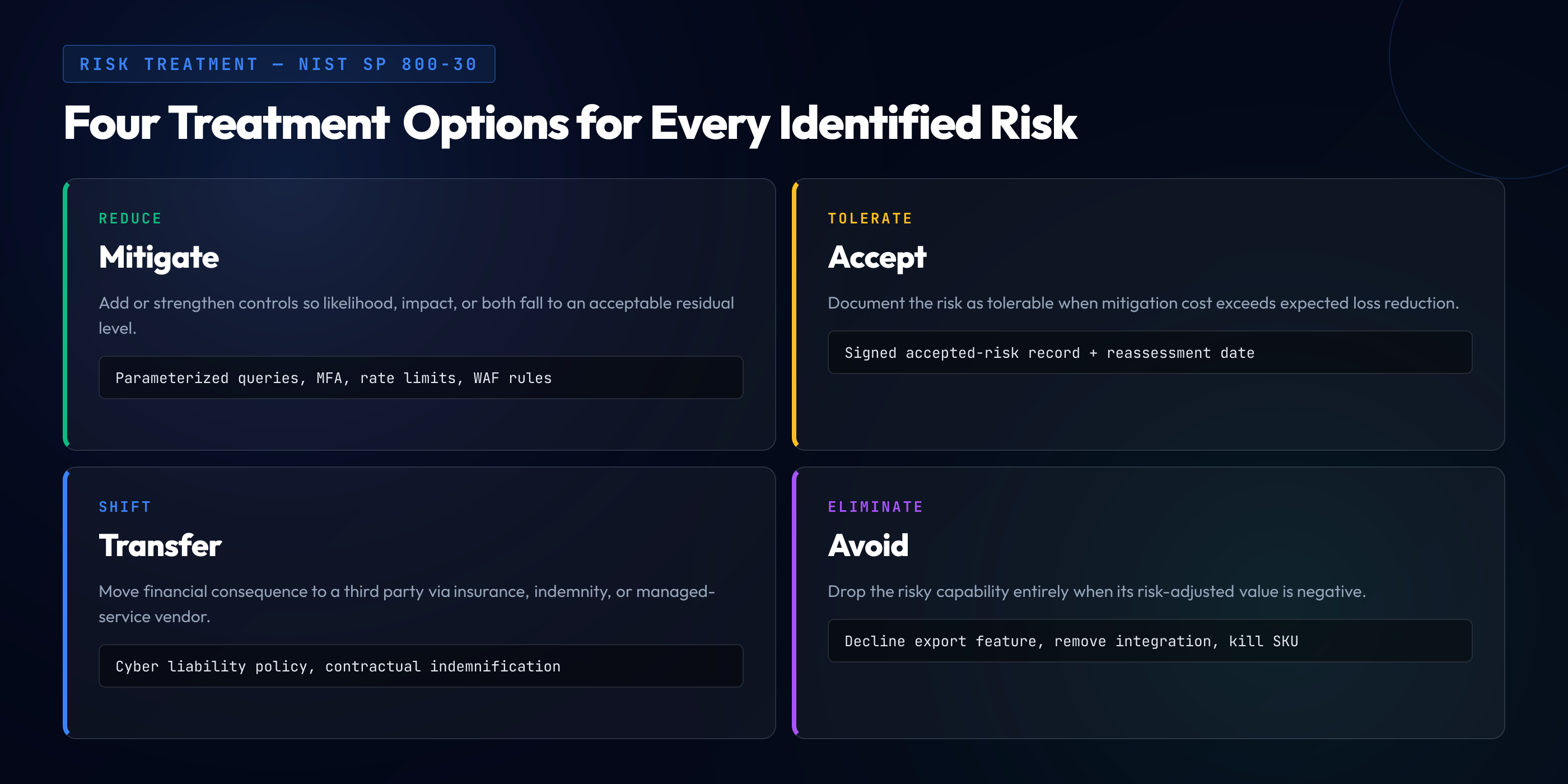
Once a risk is identified, analyzed, and evaluated, the organization picks a treatment. There are exactly four canonical options, and despite occasional attempts to add a fifth (like "monitor"), the four cover the actual decision space. Each one has concrete engineering implications.
Mitigate. Add or strengthen controls so the risk's likelihood, impact, or both are reduced to an acceptable level. This is the option engineering teams see most often because most identified risks get mitigated. Examples: implementing parameterized queries to mitigate SQL injection risk, enabling MFA to mitigate credential compromise risk, adding rate limits to mitigate denial-of-service risk, deploying a WAF to mitigate web-tier injection risk. The mitigation becomes a backlog ticket (or a portfolio of tickets), gets implemented, and the residual risk is reassessed.
Accept. The organization decides the risk is tolerable as-is and chooses not to spend the resources to reduce it further. Acceptance is legitimate when the risk falls below the organization's appetite, the cost of further mitigation exceeds the expected loss reduction, or the mitigation would compromise other objectives (usability, performance, time-to-market). The discipline that makes acceptance legitimate rather than negligent is documentation: an accepted-risk record naming the risk, the rationale for acceptance, the executive who approved it, and the date for reassessment. An accepted risk that is reassessed annually is a managed risk; an accepted risk that nobody revisits is a pending incident with paperwork.
Transfer. Move the financial consequence of the risk to a third party — most commonly through insurance (cyber liability), but also through contractual indemnification, outsourcing the risky activity, or structurally shifting liability. Cyber insurance carriers in 2026 are aggressively selective about what they cover; the days of comprehensive cyber policies with low deductibles are largely over. Transfer remains a valid treatment for financial-loss-driven risks (ransomware payment costs, breach notification costs), but the engineering team rarely sees this option directly because it is decided at the corporate-finance level. Where engineering does see transfer is in vendor risk: choosing a managed service over self-hosting transfers operational and security risk to the vendor, with corresponding cost and control tradeoffs.
Avoid. Eliminate the risky capability altogether. The feature does not ship, the data is not collected, the integration is not built. Avoidance gets stigmatized as "saying no to the business" but is sometimes the correct answer — the risk-adjusted value of a capability can be negative, and shipping it anyway is poor risk management. Engineering examples: declining to add an export feature that would expose restricted data, deciding not to integrate with a third-party service whose security posture has not been validated, removing an existing feature whose security debt has accumulated past the cost of replacement.
The treatment selected depends on the residual-risk math. A risk reduced to "low" by mitigation may still warrant acceptance of the residual rather than further mitigation. A risk where mitigation would cost more than the expected loss is a transfer or accept candidate. A risk where the underlying capability has marginal value is an avoid candidate. The decision is a portfolio decision across the register, not a per-risk one.
Residual Risk: The Part Nobody Documents
Residual risk is the risk that remains after the chosen treatment is applied. Every mitigation has a residual: parameterized queries do not eliminate SQL injection risk to zero (they reduce it dramatically, but a developer can still write a query with a raw string concatenation), MFA does not eliminate credential compromise risk (push-bombing, SIM-swap, OAuth refresh-token theft remain), monitoring does not eliminate detection failure risk (alerts can be disabled, runbooks can be ignored). The residual is the risk that survives the controls.
The reason residual risk matters disproportionately to its discussion frequency is that residual risks are inherited. When a service moves between teams, when a leadership change happens, when an acquisition merges two organizations, the residual risks travel with the assets and become the new owners' problem. A risk register that only documents the original risks and the chosen treatments — without explicit residual-risk entries — is a register that lies about the system's actual exposure. The team taking ownership reads "mitigated" and assumes the risk is gone; the engineer who actually has to debug the next incident discovers it was not.
The discipline that makes residual risk visible is mechanical: every mitigation entry in the register includes a corresponding residual entry, scored independently. The residual is reassessed when controls change, when threat intelligence indicates new adversary capability, or when the asset's classification or exposure changes. Organizations that treat residual risk as a first-class register entry tend to make better treatment decisions because the comparison is honest — "we can mitigate this risk to a residual of X, or accept the original risk at Y" is a real choice, while "we'll mitigate it" without the residual visible is an evasion.
Continuous Risk Assessment in CI/CD
The traditional cybersecurity risk assessment is annual — sometimes quarterly. The system being assessed is daily, sometimes continuous. The gap between assessment cadence and system-change cadence is the gap that produces stale registers, and the engineering response in 2026 is continuous risk assessment: the registry is updated, in part automatically, every time the underlying conditions change.
The mechanism is straightforward. The CI/CD pipeline already produces signals that are risk-relevant: SAST findings, DAST findings, SCA findings, container scan findings, IaC scan findings, secret-scanning findings. Each finding is a vulnerability discovery that, mapped against the existing threat catalog and asset classification, becomes a risk register entry (or an update to an existing one). The work is the mapping, not the discovery; the discovery is already happening.
A representative pipeline integration: every PR runs SAST. SAST findings tagged with high or critical severity flow into the risk-tracking system, are correlated to the affected asset and its data classification, and are scored contextually. Findings above the organization's risk threshold become tickets with explicit priority; findings below the threshold are aggregated and reviewed at the next sprint or quarterly cadence. The engineer sees the relevant ones in the PR; the risk register sees all of them as live entries. The same pattern applies for DAST runs against staging, SCA runs on dependency updates, and IaC scans on Terraform PRs. For an end-to-end view of how the application security testing tools differ in what they catch — and which combinations actually feed the risk inputs the assessment needs — our SAST vs DAST vs IAST comparison guide walks the tooling layer the continuous risk assessment depends on.
The discipline that makes the continuous assessment honest is the closure of the loop in both directions. New findings flow into the register as risks; treated risks flow back as suppressions or accepted-risk records. A register that only adds entries grows monotonically and eventually becomes unreadable; a register that closes entries when the underlying risk is treated remains a working tool. Organizations that pipe their security tooling output into a register without a closure mechanism end up with a register that is technically continuous but operationally a graveyard.
The Risk Register: Schema and Examples
The risk register is the artifact that ties the assessment together. Whatever framework, scoring methodology, or treatment policy the organization uses, the register is where they materialize as concrete entries. A workable schema for an engineering-aligned risk register has roughly these fields:
id: RISK-2026-00342
asset: payments-api
asset_classification: restricted
threat: external attacker exploits SQL injection in /v1/orders endpoint
threat_actor_capability: medium (commodity scanners + manual testing)
vulnerability:
  cwe: CWE-89
  source: SAST finding 4421
  cvss_base: 8.6
  contextual_score: 6.2
  epss_30d: 0.012
likelihood: 3 (Possible)
impact: 5 (Severe — restricted data exfiltration)
risk_score: High
treatment: mitigate
mitigation:
  control: parameterized queries via repository layer
  ticket: PAY-9821
  due: 2026-05-15
  owner: payments-team
residual_likelihood: 1 (Rare)
residual_impact: 5 (Severe)
residual_score: Medium
review_due: 2026-11-15
status: open
last_reviewed: 2026-04-25
The schema choice matters less than the discipline of populating it. A register where 60% of entries have an empty residual_score field is a register that has stopped being maintained. A register where treatments have due dates that all read "TBD" is a register that is decoupled from the engineering backlog. The format is flexible; the operating discipline is not.
The register is most useful when it lives where the engineering team already works. A register in a security-team-only system that engineers have to ask for access to is a register that does not influence engineering decisions. A register surfaced as a Jira project with cross-references to the affected services, or a register exposed as a read-only API into the engineering wiki, becomes part of the team's information environment. The integration matters more than the tooling.
Compliance Frameworks That Require Risk Assessments
The risk assessment is useful in its own right; it is also the artifact most compliance frameworks specifically require. The overlap is large enough that running compliance and risk-assessment programs as separate streams burns operational time on redundant activities.
PCI DSS 4.0.1. Requirement 12.3.1 mandates a documented risk analysis at least annually for the cardholder data environment, with specific requirements for the methodology, scope, and treatment of identified risks. The CDE assets, their threats and vulnerabilities, and the scoring all become evidence in the QSA assessment. A general it security risk assessment that excludes the CDE produces a finding; a CDE-scoped risk assessment that does not connect to the engineering backlog produces a different finding. For the operational counterpart on the technical side, our PCI DSS vulnerability scanning guide covers how scan findings feed the risk register.
NIST SSDF and CSF 2.0. The NIST Cybersecurity Framework's Identify function (ID.RA — Risk Assessment) is the explicit hook for risk assessment activity. SSDF Practice PO.5 (Implement and Maintain Secure Environments for Software Development) implicitly assumes a risk-assessment input.
SOC 2 (CC3.x, CC9.x). The Common Criteria for risk identification, analysis, and mitigation are direct mappings to a risk assessment process. CC3.2 requires risk identification and analysis; CC3.3 requires risk acceptance based on risk tolerance; CC3.4 requires monitoring of identified risks. A SOC 2 audit without a working risk assessment process produces findings.
ISO 27001:2022. Clause 6.1.2 specifically requires an information security risk assessment process, and ISO 27005 is the companion standard for the methodology. Annex A controls are largely chosen via the risk-assessment output; the Statement of Applicability (SoA) is the bridge between the risks and the chosen controls.
EU Cyber Resilience Act and NIS2. Both regulations require risk assessment as part of the secure development and operational obligations for in-scope organizations. The CRA's Annex I obligations explicitly reference risk-based design and risk-based vulnerability handling.
The pattern that survives multiple compliance regimes is to run the risk assessment process once, at a fidelity that meets the most demanding applicable framework, and use the output as evidence across all of them. The evidence is the same; the framing per audit is what changes. Organizations that run separate risk assessments for each compliance regime burn time on parallel work and produce inconsistencies their auditors will find.
Common Pitfalls That Make Risk Assessments Theater
The risk-assessment programs that fail tend to fail in a small number of recognizable ways. Naming them is the cheapest defense.
Heat maps as decisions. The risk register exists, the heat map gets produced, and the colored cells become the answer. No further analysis happens on the "Critical" risks; no trigger threshold exists for re-evaluation; the heat map is the artifact. Heat maps are a triage tool, not a decision tool. The organizations that mature past this pattern use the heat map to identify which risks need deeper analysis (often quantitative) and then use the deeper analysis to drive decisions.
"High / Medium / Low" without thresholds. The register has every risk rated, but no documented thresholds for what each rating means in terms of treatment, escalation, or review cadence. The result is that "High" risks sit in the register for a year because nothing in the process actually requires action when the rating is "High". Mature programs document, per rating, the required treatment lead time, the escalation level for acceptance, and the reassessment frequency.
Risk register as audit artifact only. The register is updated annually, exists as a document for the auditor, and has no operational role. Engineering teams do not see it; treatment decisions do not flow through it; new findings do not get added to it. The register is preserved for compliance and ignored for actual risk management. The recovery is to wire the register into the engineering workflow — every PR with a security finding produces a register update, every accepted risk has a real owner with calendar reminders for reassessment, every quarterly review pulls the open entries.
Inheriting CVSS as risk. Every CVE in the SCA tool gets imported as a "risk" with the CVSS base score copied as the risk score. The register fills with a thousand entries that are technically risks but practically noise, because the contextual transformation has not been applied. The engineering team learns to ignore the register because it does not reflect actual exposure; the audit team gets exactly what they asked for and not what they needed.
Confusing risk assessment with vulnerability management. The vulnerability scanner output is treated as the risk assessment. This is a category error: the scanner produces vulnerability findings, which are an input to risk assessment, not the assessment itself. A program that conflates the two ships a "risk register" that is really a vulnerability backlog, missing the threat-and-impact analysis that makes a risk assessment a risk assessment.
One-time exercise, not a process. The assessment runs once, produces a register, and the register is filed. The threat landscape evolves, the system evolves, the controls evolve, and none of it is reflected. By month six, the register is fiction. The risk assessment that survives is the one that is treated as a continuous activity — reassessed when assets change, when threat intelligence indicates new adversary behavior, when incidents reveal control gaps, when compliance scope expands.
The Risk-to-Backlog Loop in Practice
The integration that produces the most engineering value is the loop from risk register to engineering backlog and back. The mechanics are not complicated; the discipline to maintain them is. The loop has four points where the register and the backlog touch, and each one needs an explicit owner.
Risk identification produces backlog candidates. When a new risk is added to the register — from a threat-modeling session, a pentest, a SAST finding, an incident — the treatment decision either creates a backlog ticket (mitigate) or a tracking record (accept, transfer, avoid). The ticket carries the risk ID as a reference and inherits the priority from the risk score. A risk identification that does not produce a corresponding backlog or tracking entry is a risk identification that has been silently lost.
Backlog completion updates the residual risk. When a mitigation ticket completes, the corresponding register entry is updated: the residual risk is reassessed, the status changes to "treated," and the next reassessment date is set. A mitigation that completes without the register update means the register stops reflecting actual exposure. The recovery is automation: the ticket-tracking system fires a webhook on completion that opens a register update; a human reviews and confirms.
Architecture review consults the register. When a new design crosses the architecture-review threshold, the existing register entries for the affected assets are pulled as input. The review explicitly considers whether the new design adds new risks (which need to be added to the register), changes existing risk likelihoods or impacts (which need re-scoring), or addresses existing risks (which can be moved toward closure). Architecture review without register integration produces designs that ignore the upstream risk picture; architecture review with register integration produces designs that address it.
Incidents close back to the register. When an incident occurs, the post-incident review explicitly checks whether the underlying risk was in the register, whether it was scored accurately, and whether the treatment was appropriate. The register is updated based on what was learned: new threats added, scoring adjusted, treatments revised. Incidents that close without register integration are incidents whose lessons stay with individual responders rather than improving the organizational risk view.
The four-point loop is the operational reality of a working risk assessment program. The framework selected, the scoring methodology applied, the register schema chosen — all matter less than whether this loop is running. Organizations with sophisticated risk management vocabulary and no functioning loop produce the audit-artifact pattern. Organizations with simple vocabulary and a functioning loop produce the operational-tool pattern. The second outcome is the one that actually reduces risk.
Risk Assessments Only Work When the Engineering Team Can Execute
A cybersecurity risk assessment that names "SQL injection" as a high risk does not, by itself, prevent SQL injection. The mitigation depends on developers who can recognize unsafe query construction in their own language, write the parameterized version reflexively, and review their teammates' code with the same fluency. SecureCodingHub builds the developer capability that turns risk-register mitigations into shipped code — language-specific, hands-on training tied to the risk-driving vulnerability classes that show up in your SAST and pentest findings. If your risk register has more "open" entries than "treated" ones, the gap is usually capability, not intent.
See the PlatformWhat Engineering Leaders Should Take Away
If you are an engineering leader inheriting or building a risk assessment program, the practical pattern that holds up across organizational contexts has a few consistent properties. The risk register lives where engineers already work, not in a parallel security-team system. The scoring is qualitative for triage and quantitative for the handful of risks that drive material investment decisions, not one or the other applied uniformly. The treatment decisions produce real backlog tickets with owners and dates, not entries with status fields that never change. The CVSS scores from your SCA and pentest tooling are inputs that get contextualized into the register, not outputs that get inherited unchanged. The residual risks are documented as first-class entries, not implicit assumptions. The loop from register to backlog to architecture review to incident retrospective and back runs continuously, not annually.
The frameworks — NIST, ISO 27005, OCTAVE, FAIR — are aspirational references. The trajectory of your actual program is organizational. Pick the framework that makes the loop easier to sustain in your specific context, build the four-point integration with the engineering workflow, and resist the gravitational pull of running the assessment as a parallel compliance program rather than as the input to the work the engineering team is already doing. The risk register that drives the next sprint's tickets is worth the entire investment in the assessment process; the risk register that sits in SharePoint is worth a fraction of it.
The vulnerability classes that appear most often as register entries — injection, broken access control, security misconfiguration, supply chain compromise — are the same ones that appear most often in the OWASP Top 10 risk catalog, and the connection is not a coincidence. The Top 10 is the highest-frequency subset of what risk assessments tend to identify in modern web and API applications, which means a developer fluent in the Top 10 has the mental model to recognize most of the patterns the risk register will surface. The risk assessment tells you the size and priority of the problem; the developer's secure coding fluency is what closes the loop. Without the second half, the first half is documentation; together, they are an operating system for managing cyber risk through the team that ships the code.